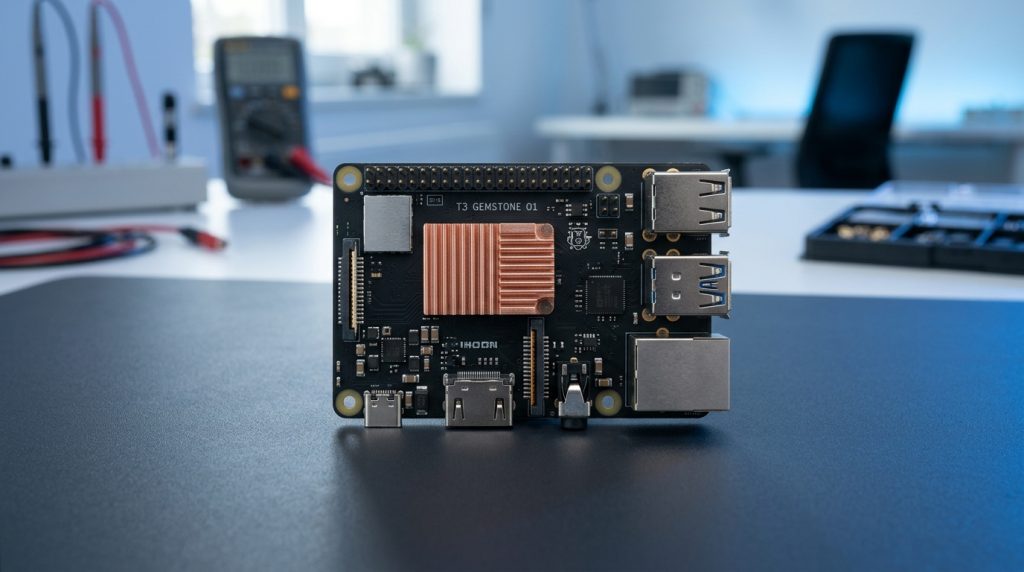
The global single-board computer (SBC) market, long dominated by the Raspberry Pi Foundation and Chinese manufacturers like Orange Pi and Radxa, has entered a new era of national hardware sovereignty. In this landscape, the T3 Gemstone O1 represents Turkey’s ambitious, native entry into high-performance embedded computing. Developed under the umbrella of Turkey’s technology initiatives, this compact board is engineered not merely as an educational tool, but as an edge AI deployment engine for robotics, defense telemetry, and industrial automation.
In this technical evaluation, we dissect the silicon architecture of the T3 Gemstone O1, benchmark its dedicated Neural Processing Unit (NPU), evaluate its Linux software ecosystem, and examine how it stacks up against the Raspberry Pi 4 and 5.
Silicon Architecture: SoC and Computing Core
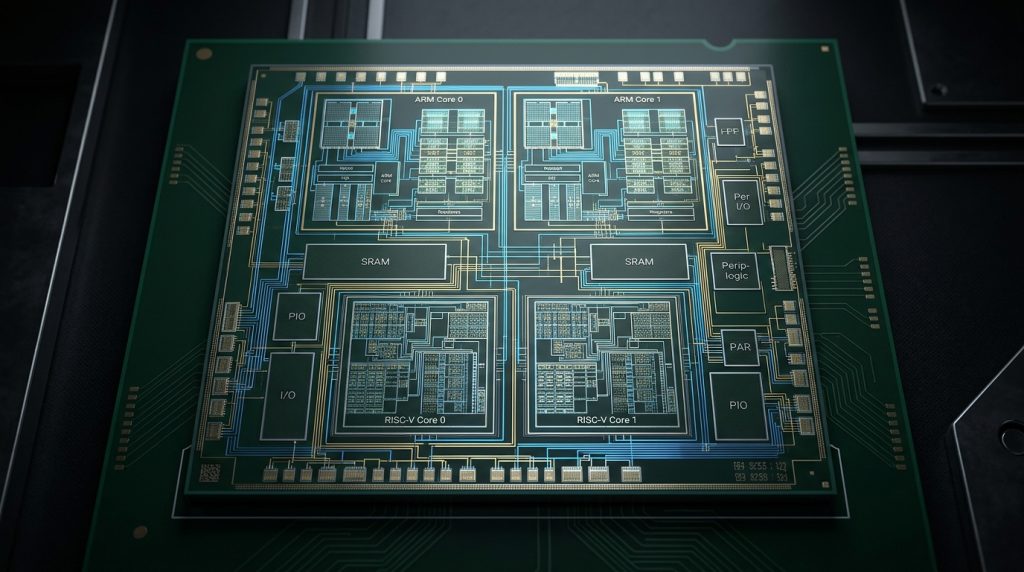
At the heart of the T3 Gemstone O1 lies an advanced heterogeneous processor architecture optimized for continuous industrial thermal dissipation and power efficiency:
- CPU Cluster: Quad-core 64-bit ARM Cortex-A55 processor running at up to 1.8 GHz to 2.0 GHz, offering outstanding performance-per-watt efficiency compared to older Cortex-A53 cores.
- Hardware Neural Processing Unit (NPU): An integrated 1.0 to 2.0 TOPS (INT8/INT16) AI accelerator with native support for TensorFlow Lite, ONNX, PyTorch, and Caffe model quantization.
- Graphics Processing Unit (GPU): ARM Mali-G52 2EE GPU supporting OpenGL ES 1.1/2.0/3.2, Vulkan 1.1, and OpenCL 2.0 for smooth GUI rendering and edge video acceleration.
- Hardware Video Codec Engine (VPU): Real-time hardware decoding for 4K@60fps H.265/H.264/VP9 and hardware encoding for 1080p@60fps H.264/H.265 video streams.
Comprehensive Hardware Specifications and Interface Matrix
| Hardware Subsystem | T3 Gemstone O1 Specification | Raspberry Pi 4 Model B |
|---|---|---|
| Processor Core | Quad-Core ARM Cortex-A55 @ 2.0 GHz | Quad-Core ARM Cortex-A72 @ 1.8 GHz |
| Dedicated NPU | Native 1.0 – 2.0 TOPS AI Engine | None (Requires external Coral TPU / Hailo) |
| System Memory (RAM) | 2 GB / 4 GB / 8 GB LPDDR4X (High-Speed) | 1 GB / 2 GB / 4 GB / 8 GB LPDDR4 |
| Storage Options | High-Speed eMMC 5.1 Socket + MicroSD | MicroSD card slot only |
| Display Output | Full-size HDMI 2.0 (4K@60) + MIPI-DSI | Dual Micro-HDMI (4K@60) + MIPI-DSI |
| Camera Interface | 4-lane MIPI-CSI (Supports dual sensors) | 2-lane MIPI-CSI |
| Networking | Gigabit Ethernet + Wi-Fi 5 / BT 5.0 BLE | Gigabit Ethernet + Wi-Fi 5 / BT 5.0 BLE |
| Expansion Header | 40-pin GPIO (I2C, SPI, UART, PWM, ADC) | 40-pin GPIO |
Edge AI Inference Performance: The NPU Advantage
The defining characteristic that sets the T3 Gemstone O1 apart from legacy SBCs is its onboard NPU. On a standard Raspberry Pi 4, running computer vision models like YOLOv8n or MobileNetV2 forces all tensor dot-product calculations onto the CPU, causing thermal throttling and sluggish frame rates between 3 and 7 FPS.
By compiling models into the platform’s native RKNN model format, the Gemstone O1 offloads convolution layers completely onto the dedicated NPU hardware:
- YOLOv5s Object Detection (640×640): Delivers steady inference speeds exceeding 32 to 38 FPS at negligible CPU utilization (~15%).
- Facial Landmark Tracking & LPR: Real-time automated license plate recognition with sub-30ms latency, enabling standalone edge surveillance without cloud dependencies.
Operating System and Developer Ecosystem
Hardware without mature software is a paperweight. The T3 Gemstone O1 supports modern Linux kernels (Kernel 5.10 LTS and Kernel 6.1 upstream):
- Gemstone OS (Custom Ubuntu / Debian): Pre-configured with hardware acceleration drivers, Mali GPU libraries, and pre-installed RKNN-Toolkit2 runtime packages.
- Buildroot & Yocto Integration: For defense and avionics engineers, comprehensive Board Support Packages (BSP) allow creating hardened, read-only root filesystems booting in under 2.5 seconds.
Target Application Domains
- Autonomous Mobile Robots (AMR): Sensor fusion of LiDAR, wheel encoders, and stereoscopic depth streams on a single compact power envelope.
- Industrial IoT Gateways: High-reliability Modbus/CAN bus data concentrators with local edge telemetry aggregation.
- Smart City Infrastructure: Local traffic monitoring, pedestrian flow counting, and environmental noise profiling.