
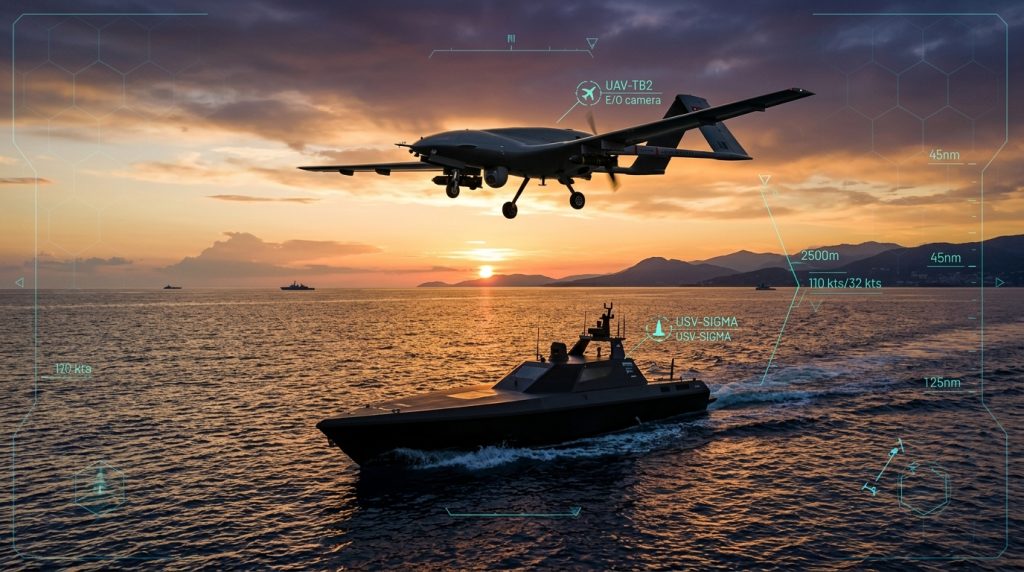
Modern warfare is rapidly moving away from solitary, heavy capital platforms toward decentralized, highly resilient networks of autonomous systems operating across air, surface, and subsurface domains. Coordinated by the Turkish Ministry of National Defense and the Turkish Naval Forces in the Gulf of Antalya and the Eastern Mediterranean, the TURNAs-2026 National Unmanned Naval Systems Exercise demonstrated this integrated multi-domain doctrine in full operational scale.
Rather than simply testing unmanned vessels in isolation, the exercise demonstrated real-time airborne command handoff to sea-skimming strike platforms, high-speed kinetic drone interception, and record-setting close-in weapon systems operating in concert. In this comprehensive review, we examine the core hardware architectures, tactical integration, and engineering milestones unveiled during TURNAs-2026.
Air-to-Surface Command Relaying: Bayraktar TB2 and MKE PIRANA
The definitive highlight of TURNAs-2026 was a world-first operational demonstration: The PIRANA Kamikaze Unmanned Surface Vessel (USV), engineered by Mechanical and Chemical Industry Corporation (MKE), was piloted and guided directly from an airborne Bayraktar TB2 UCAV to successfully obliterate a designated naval surface target.
In conventional USV operations, line-of-sight (LOS) radio propagation between shore stations and surface vessels degrades significantly beyond the horizon due to Earth’s curvature and sea clutter. By leveraging the Bayraktar TB2 as an elevated aerial communications relay and targeting hub, operators bypassed littoral RF limits and directed PIRANA over hundreds of nautical miles with zero signal degradation.
- High-Speed Interception: PIRANA sustains speeds in excess of 40 knots (approx. 74 km/h), drastically compressing enemy point-defense reaction windows.
- Operational Reach: An effective combat radius surpassing 200 nautical miles enables autonomous deep-littoral missions.
- Heavy Payload Capacity: Its 100 kg specialized warhead delivers devastating structural shockwaves sufficient to neutralize corvette and frigate-sized surface combatants.
- Stealth Hydrodynamic Design: Low radar cross-section (RCS) geometry coupled with advanced composite hull fabrication minimizes thermal and radar signatures.
STM TUNGA-X: Kinetic Anti-Drone Interception at 300 km/h
As the threat of asymmetric suicide drones proliferates across active theaters, expending multi-million-dollar surface-to-air missiles against inexpensive loitering munitions has created an unsustainable economic imbalance. STM’s TUNGA-X Hunter UAV presents an agile, cost-effective countermeasure: utilizing an unmanned aircraft to neutralize incoming drones via direct kinetic impact.
During live tracking engagements at TURNAs-2026, TUNGA-X leveraged tactical radar cues and integrated nose-mounted electro-optical/infrared computer vision algorithms to autonomously home in on an aggressor drone. Accelerating up to 300 km/h, TUNGA-X executed a precision strike directly into the target’s propeller hub without detonating its own explosive warhead. This hit-to-kill method eliminates collateral shrapnel risks near civilian vessels and preserves high-value munitions.
MKE TOLGA Close-In Weapon System: 3,200 Rounds Per Minute
To defend maritime assets against saturation swarms of aerial and surface kamikaze drones, MKE unveiled the navalized TOLGA Close-In Weapon System (CIWS) integrated aboard patrol ship TCG BEYKOZ for live-fire qualification.
Featuring a 20 mm Twin Revolver Cannon layout, TOLGA unleashes a devastating cyclic rate of 3,200 rounds per minute—roughly triple that of legacy counterparts. The weapon system pairs this volume of fire with MKE’s “Effective, Simple, and Inexpensive” (EBU) airburst ammunition philosophy:
- Fragment Cloud Interception: Timed 20 mm rounds fragment downrange into dense tungsten pellet clouds, establishing an impenetrable barrier against incoming surface drones and loitering munitions.
- 1,000-Meter Engagement Zone: High-threat targets are destroyed well before reaching the vessel’s critical inner defense perimeter.
- Dynamic Gyro Stabilization: Dual-axis stabilized optronic and radar-assisted turrets maintain continuous lock-on amid rough sea states and high-speed evasive maneuvering.
Anti-Submarine Warfare Evolution: Bayraktar TB3 and Sonobuoy Processing
Complementing surface and aerial trials, short-takeoff-and-landing Bayraktar TB3 drones operating from amphibious carrier TCG ANADOLU executed acoustic sonobuoy deployment and processing tests in the Eastern Mediterranean. By deploying active and passive sonobuoys and relaying processed telemetry directly into tactical naval battle networks, TB3 adds persistent airborne Anti-Submarine Warfare (ASW) tracking to Turkey’s uncrewed inventory.
Strategic Impact and Autonomous Doctrinal Shift
TURNAs-2026 cements the evolution of the Turkish defense manufacturing ecosystem from standalone hardware production to a unified “System of Systems” paradigm. By synchronizing high-altitude UCAVs, low-RCS kamikaze surface vessels, kinetic hunter drones, and rapid-fire naval CIWS into a distributed data fabric, Turkey continues to redefine littoral deterrence and maritime combat doctrine on the global stage.
Sources and References
This technical doctrine report was compiled from official defense exercises and technical publications:
- SavunmaSanayiST – Dünyada İlk: Kontrol TB2’den Vuruş PİRANA’dan
- SavunmaSanayiST – MKE TURNAs-2026’da: TOLGA ve PİRANA Hava ve Deniz Hedeflerini Vurdu
- SavunmaSanayiST – Saatte 300 km ile Avlıyor: TUNGA-X Hedef İHA’yı Düşürdü
- SavunmaSanayiST – Bayraktar TB3 Sonoboy ile Denizaltı Savunma Harbi Testleri