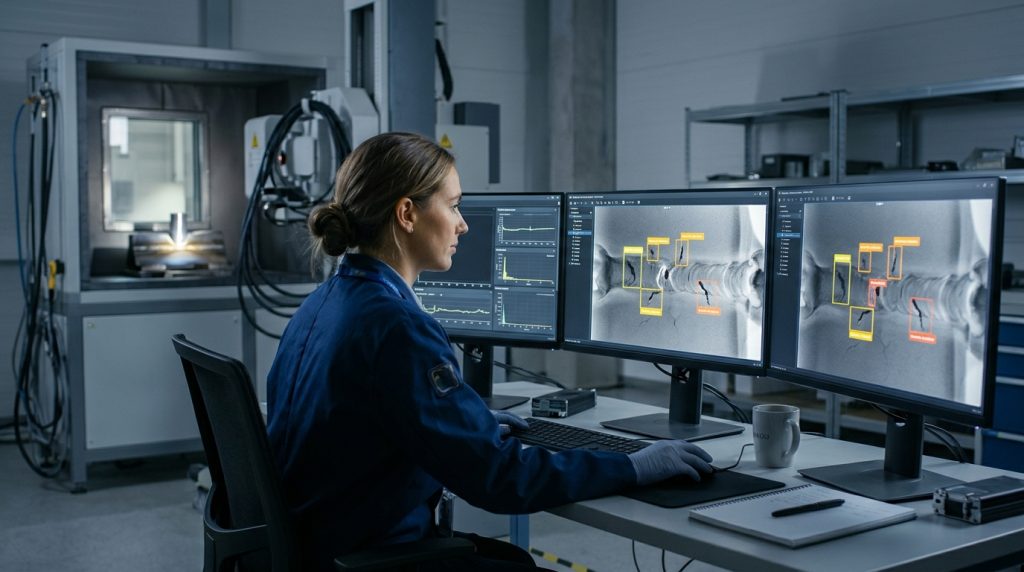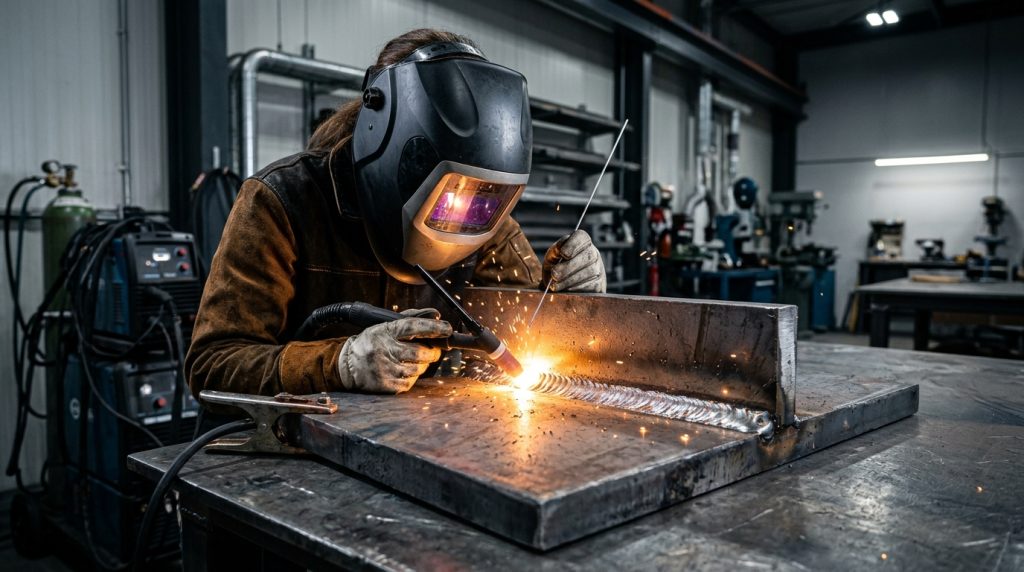
In structural steel fabrication, pressure vessel construction, and oil & gas pipeline installation, welding high-strength low-alloy (HSLA) steels introduces severe metallurgical risks. The most hazardous is Hydrogen-Induced Cold Cracking (HICC)—also known as delayed cracking—which occurs in the Heat-Affected Zone (HAZ) hours or days after welding. To assess a steel’s susceptibility to hardening and cracking, metallurgists rely on the Carbon Equivalent (CE) metric.
Why Chemical Composition Dictates Weldability
While carbon ($C$) is the primary element that increases steel tensile strength, other alloying elements (Manganese, Chromium, Molybdenum, Vanadium, Nickel, Copper) also increase hardenability. During rapid cooling after welding, these elements promote the formation of brittle, needle-like martensite microstructures. The Carbon Equivalent mathematical formulas convert all these alloying elements into an equivalent percentage of elemental carbon.
Standard Carbon Equivalent Formulas
1. International Institute of Welding (IIW) Formula
The standard formula for medium and high-carbon structural steels ($C > 0.18\%$):
CE(IIW) = C + (Mn / 6) + ((Cr + Mo + V) / 5) + ((Ni + Cu) / 15)
2. Ito-Bessyo Cracking Parameter (Pcm)
Widely utilized for modern low-carbon micro-alloyed pipeline steels ($C < 0.18\%$, API 5L grades):
Pcm = C + (Si / 30) + ((Mn + Cu + Cr) / 20) + (Ni / 60) + (Mo / 15) + (V / 10) + (5 * B)
Weldability Evaluation Benchmarks
| CE(IIW) Range | Weldability Classification | Preheat & Interpass Requirements |
|---|---|---|
| < 0.35% | Excellent Weldability | Generally no preheating required for standard thicknesses |
| 0.35% – 0.45% | Good Weldability | Preheating recommended for heavy plate thicknesses (>25mm) and low-hydrogen electrodes |
| 0.45% – 0.55% | Moderate / Caution Required | Mandatory preheating (100°C–200°C), controlled heat input, low-hydrogen consumables |
| > 0.55% | Difficult Weldability | High preheat (200°C–350°C), post-weld heat treatment (PWHT) required to temper martensite |
Determining Minimum Preheat Temperatures
Higher carbon equivalent values require elevating the workpiece preheat temperature before striking an arc. Preheating slows the cooling rate ($t_{8/5}$), allowing trapped diffusible hydrogen atoms to escape harmlessly out of the weld pool rather than concentrating in micro-voids to cause brittle catastrophic fracture.