In safety-critical industries such as aerospace, nuclear energy, offshore pipelines, and pressure vessel manufacturing, structural failure is not an option. For decades, Industrial Radiographic Testing (RT) relied on silver-halide photographic film to inspect welds and castings for internal flaws (cracks, porosity, lack of fusion). However, conventional film requires hazardous chemical developing darkrooms, hours of processing delay, and expensive physical archive vaults.
The global quality assurance industry has decisively transitioned into Digital Non-Destructive Testing (NDT 4.0), spearheaded by Digital Radiography (DR) and Computed Radiography (CR).
Digital Radiography (DR) vs Computed Radiography (CR)
| Technology | Image Capture Mechanism | Workflow Advantages |
|---|---|---|
| Computed Radiography (CR) | Flexible phosphor imaging plates (IP) that trap latent X-ray energy; read via laser scanner | Replaces film cassettes directly; reusable thousands of times; flexible for wrapping around pipes |
| Digital Radiography (DR / DDA) | Rigid Flat Panel Digital Detector Arrays using amorphous silicon/selenium and CsI scintillators | Instantaneous real-time image acquisition (seconds); lowest radiation dose; highest dynamic range |
Key Advantages of the Digital Inspection Workflow
- Elimination of Hazardous Chemicals: Completely discards liquid developer and fixer chemistry, eliminating chemical disposal costs and environmental compliance burdens.
- Wider Dynamic Exposure Range: Conventional film has a narrow exposure latitude. If a pipe has varying wall thicknesses, multiple film exposures are required. Digital flat panels capture 14-bit to 16-bit grayscale (65,536 shades of gray), allowing technicians to inspect thin and thick sections in a single exposure.
- Advanced Digital Signal Enhancement: High-pass filtering, edge enhancement, and wall thickness measurement tools make hairline fatigue cracks instantly visible.
AI-Assisted Automated Defect Recognition (ADR)
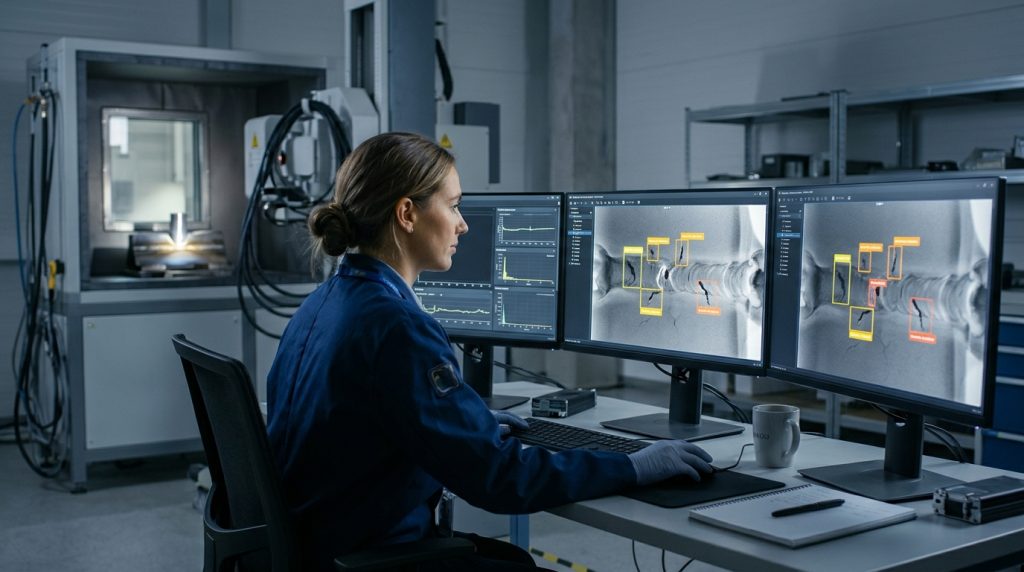
Modern NDT platforms integrate deep convolutional neural networks trained on millions of certified inspection images to automatically identify, classify, and size weld defects according to international standards (ASME Section V, ISO 17636-2, API 1104), reducing human inspector fatigue and standardizing quality control.