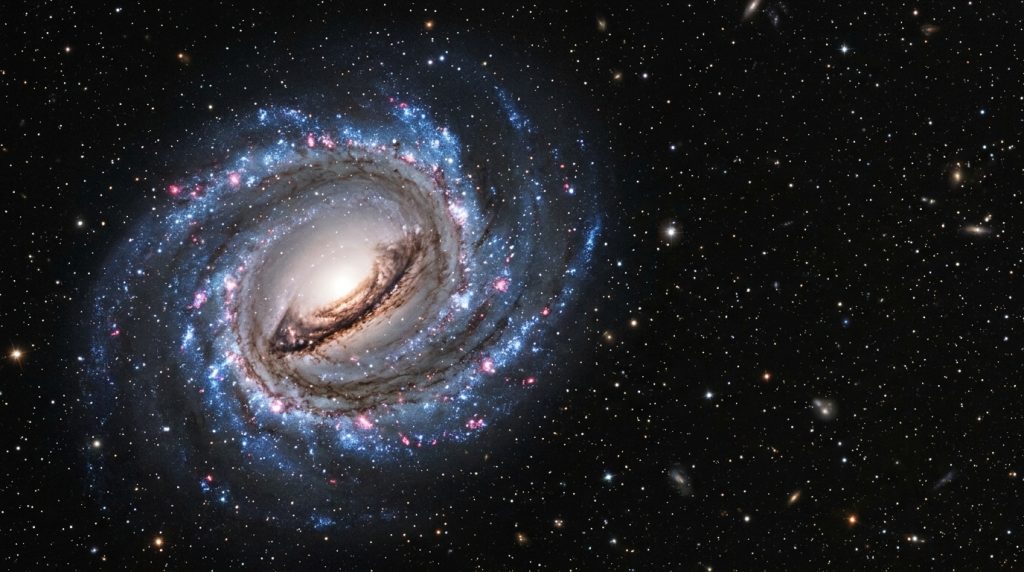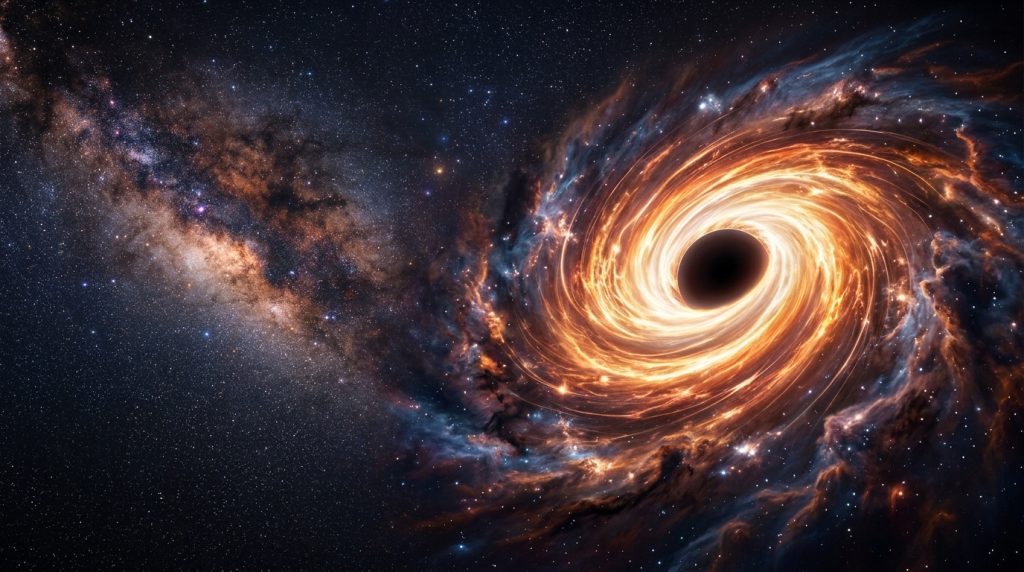
The galactic center of our Milky Way—located approximately 26,000 light-years from Earth—is one of the most violent environments in the known universe. At its heart lies Sagittarius A*, a supermassive black hole packing the mass of 4.3 million suns, surrounded by blinding X-ray flares, relativistic magnetic fields, and intense ionizing ultraviolet radiation. For decades, astrophysicists assumed that delicate molecular compounds could not long survive in this extreme radiation crucible.
The James Webb Space Telescope (JWST) has upended this assumption by detecting unmistakable spectroscopic signatures of water vapor ($H_2O$) and chemical precursors of life embedded within the dense circum-nuclear disc orbiting Sagittarius A*.
Piercing the Galactic Dust Veil with MIRI
Interstellar dust between Earth and the galactic core completely blocks optical light, dimming visible radiation by roughly 30 astronomical magnitudes (a factor of one trillion). JWST overcame this barrier using its Mid-Infrared Instrument (MIRI), operating between 5 and 28 microns, combined with its high-resolution Medium-Resolution Spectrometer (MRS).
How Water Survives Near a Supermassive Black Hole
The detection of water vapor in this extreme environment reveals a delicate balance of cosmic astrophysics:
- Dust Shielding: Dense, clumped molecular clouds with gas densities exceeding $10^5$ to $10^7$ molecules per cubic centimeter absorb harsh X-rays and UV photons at their outer boundary, shielding the cooler interior.
- Warm Shock Chemistry: Strong orbital shear and gravitational tidal forces drive supersonic shockwaves through the orbiting gas, heating the clouds to 100–300 Kelvin—the optimal temperature envelope for gas-phase neutral-neutral chemical reactions that rapidly generate water molecules.
- Prebiotic Reservoirs: Alongside water vapor, spectroscopic lines indicate carbon monoxide ($CO$), methane ($CH_4$), and polycyclic aromatic hydrocarbons (PAHs), proving that the basic building blocks of organic chemistry thrive even in the shadow of cosmic titans.
Implications for Star Formation at Galactic Centers
Water vapor acts as an efficient molecular coolant: as water molecules radiate away thermal energy, gas clouds can cool, condense under gravity, and birth new generations of hyper-metal-rich stars right in the turbulent heart of our galaxy.