When researchers completed the full FlyWire connectome of the fruit fly brain, a skeptical question immediately arose: Does having the static wiring diagram actually tell us how an organism behaves? The answer has arrived from the robotics and embodied AI community—and it is a resounding yes.
By compiling the 139,000-neuron connectome into physics simulators and embedded robotic controllers, engineers have demonstrated that biological wiring alone, without any gradient-descent pre-training or neural fine-tuning, can execute complex autonomous tasks like parallel parking, optical flow obstacle evasion, and even navigating corridors in classic video games like Doom.
Zero-Shot Optical Flow Navigation in Robots
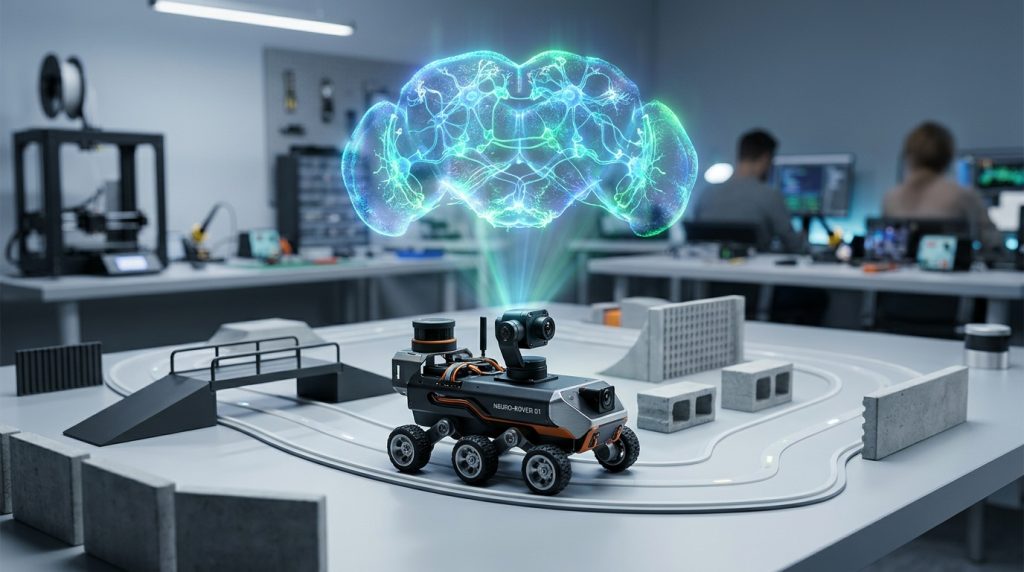
Fruit flies navigate at breakneck speeds through chaotic environments using an optic lobe circuit featuring T4 and T5 direction-selective neurons. When researchers mapped these exact circuits onto a miniature physical wheeled rover equipped with dual cameras:
- The rover spontaneously avoided collisions with walls and moving objects.
- It centered itself automatically in narrow hallways using biological motion parallax.
- Zero deep learning training was performed: the behavior emerged organically from the hardwired synaptic structure.
The Parallel Parking Breakthrough
In a celebrated simulation, roboticists connected the fly’s central complex (the brain’s compass and steering center) to a virtual car simulator. When presented with a tight parking space, the fly’s spatial orientation and backward-walking motor circuits coordinated the steering angles and reverse velocities to execute a smooth, textbook parallel parking maneuver.
Playing Doom with a Biological Neural Net
Perhaps most memorably, researchers connected the sensory inputs of the fly connectome to the screen buffer of Doom. Guided by optomotor reflex pathways, the simulated fly brain learned to explore dungeon corridors, rotate away from hostile visual stimuli, and navigate complex 3D labyrinths. This embodied bio-computing paradigm proves that biological connectomics will profoundly shape the next century of autonomous robotics.