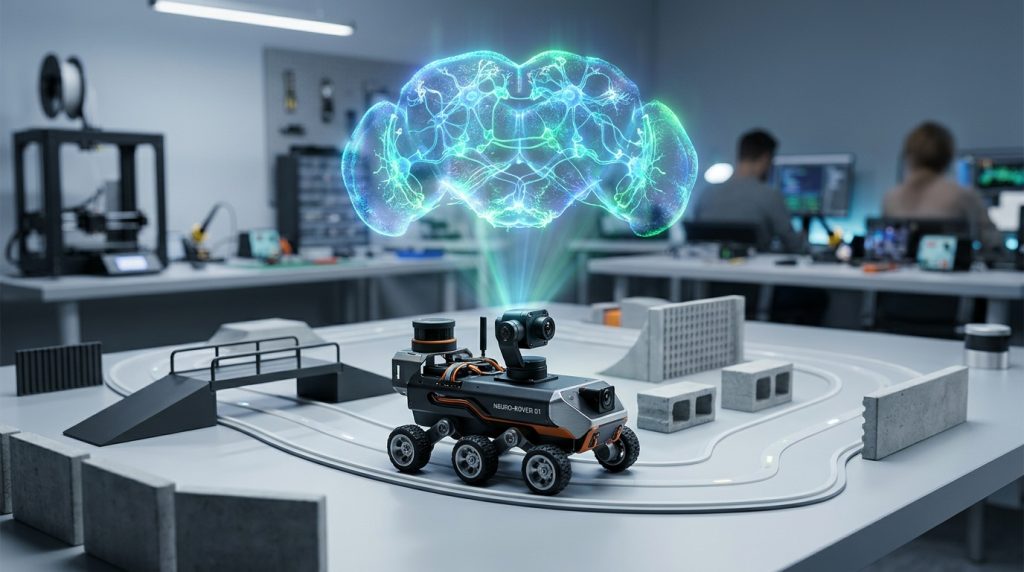
Modern Deep Neural Networks (ANNs)—including transformers like GPT-4 and convolutional networks—are extraordinarily capable, but they are energetic gluttons. The human brain, by contrast, performs real-time language, vision, motor control, and reasoning on an astonishing power budget of just 20 Watts. The secret lies in asynchronous, event-driven communication via discrete electrical pulses known as action potentials (spikes).
Spiking Neural Networks (SNNs), heralded as the 3rd generation of artificial intelligence, model this biological reality directly, paving the way for revolutionary neuromorphic hardware.
ANN vs SNN: The Fundamental Paradigm Shift
| Attribute | Traditional ANN (2nd Gen) | Spiking Neural Network (3rd Gen) |
|---|---|---|
| Information Carrier | Continuous 32-bit/16-bit floating point numbers | Discrete binary spikes (0 or 1) in temporal domain |
| Execution Model | Synchronous, layer-by-layer matrix multiplication | Asynchronous, event-driven (idle until a spike arrives) |
| Mathematical Engine | Multiply-Accumulate (MAC) operations (heavy power) | Accumulate-Only (ACC) additions (ultra-lightweight) |
| Power Consumption | High continuous power draw (GPU power hungry) | Micro-watts to milli-watts on neuromorphic silicon |
How Neurons Compute with Time: Leaky Integrate-and-Fire
The standard workhorse model for SNNs is the Leaky Integrate-and-Fire (LIF) neuron:
- Incoming spikes inject electrical charge into the membrane potential ($V_m$).
- When no spikes arrive, the potential gradually decays (“leaks”) back toward resting potential.
- When accumulated charge crosses a firing threshold ($V_{th}$), the neuron fires an instantaneous output spike and resets.
Neuromorphic Silicon: Intel Loihi and BrainScaleS
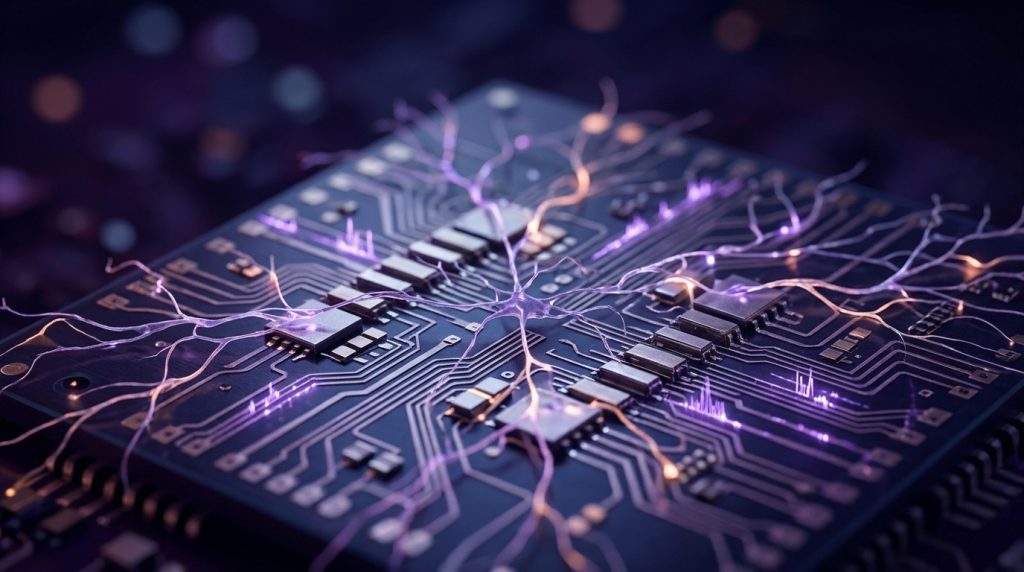
Specialized neuromorphic chips like Intel Loihi 2 and SynSense DYNAP eliminate the traditional von Neumann memory bottleneck by co-locating digital synaptic memory directly beside processing cores. They enable milliwatt-level gesture recognition, robotic tactile sensing, and edge anomaly detection for battery-operated IoT and aerospace missions.