Wireless temperature and humidity sensors are the foundational sensory organs of the modern smart home. They trigger HVAC heating zones, automate bathroom dehumidifiers, regulate wine cellars, and warn against refrigerator seal leaks. However, searching Amazon or AliExpress reveals dozens of outwardly similar Zigbee sensors ranging from $3 to $30. Are expensive branded sensors genuinely more accurate than generic white-label modules? And more importantly: which sensors actually survive inside a freezing -18°C refrigerator without dropping offline?
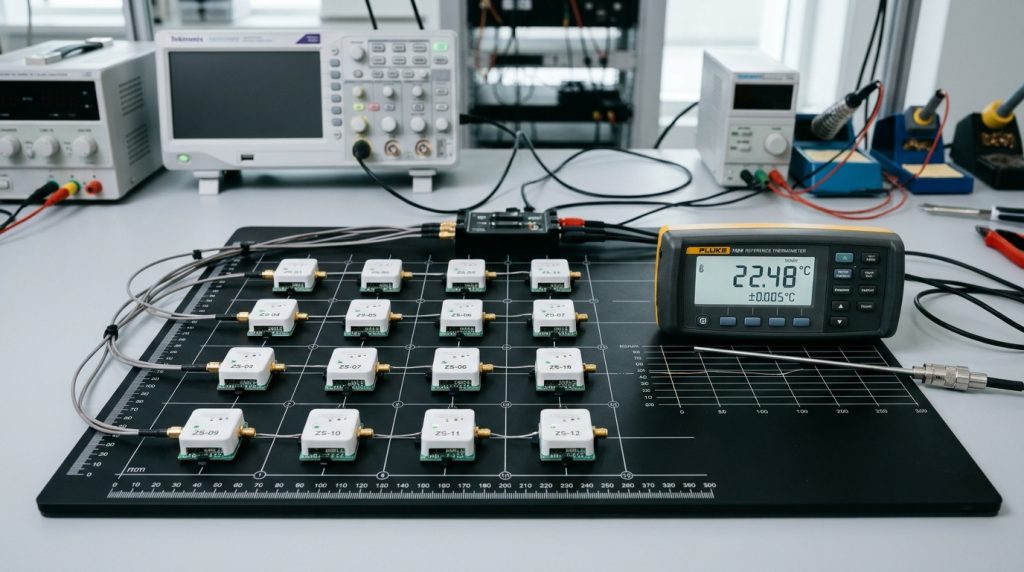
To answer these questions, we subjected the 12 most popular Zigbee climate sensors (from Aqara, Sonoff, Tuya, Xiaomi, ThirdReality, and Heiman) to a comprehensive bench calibration and a multi-week sub-zero freezer stress test.
The 12 Contenders: Sensor IC and Hardware Architecture
The accuracy and responsiveness of any environmental sensor are dictated primarily by its internal physical sensing element:
- Sensirion SHT30 / SHT40 Series (The Gold Standard): Found in Aqara and premium industrial sensors. Offers ±0.2°C temperature accuracy and ±1.5% RH precision with fast thermodynamic response times.
- AHT10 / AHT20 / AHT21 (The Value Mid-Tier): Common in Sonoff SNZB-02D and mid-tier Tuya devices. Generally reliable (±0.3°C), though prone to slight humidity drift at extreme saturation (>85% RH).
- Unbranded Analog Resistive Elements: Found in ultra-cheap ($3) Tuya round coin sensors. Sluggish response times and poor calibration linearity.
Benchmark 1: Baseline Accuracy vs Calibrated Reference
| Sensor Model | Internal Sensor IC | Battery Type | Temperature Error (ΔT) | Humidity Error (ΔRH) | Zigbee2MQTT Link Quality (LQI) |
|---|---|---|---|---|---|
| Aqara WSDCGQ11LM (Classic) | Sensirion SHT30 | CR2032 (3V) | +0.1°C (Outstanding) | +1.2% (Accurate) | 140 / 255 (Excellent) |
| Sonoff SNZB-02D (LCD Display) | AHT21B | CR2450 (High Cap) | +0.2°C (Very Good) | -2.1% (Acceptable) | 160 / 255 (Strong) |
| Tuya Round Coin Sensor (TS0201) | AHT10 | CR2032 (3V) | +0.8°C (Needs Offset) | +6.5% (High Error) | 95 / 255 (Moderate) |
| ThirdReality Gen2 Smart Sensor | Sensirion SHT40 | 2x AAA (1.5V Alkaline) | +0.1°C (Outstanding) | +0.8% (Pristine) | 210 / 255 (Superb Router) |
| Tuya Smart Life with Clock (TS0601) | Sensirion SHT30 | 2x AAA (1.5V) | +0.3°C (Good) | +2.0% (Good) | 130 / 255 (Good) |
Benchmark 2: Reporting Logic and Threshold Delays
A common smart home frustration is seeing an open refrigerator door with the temperature sensor reading a comfortable 4°C for an hour. Why? To conserve battery, Zigbee sensors employ strict firmware hysteresis:
- Threshold Reporting: Most sensors only transmit when temperature shifts by at least 0.5°C or humidity shifts by 5% RH.
- Heartbeat Interval: If temperature remains stable, sensors transmit an ambient heartbeat packet every 30 to 60 minutes.
- The Aqara and Sonoff SNZB-02D proved the fastest to broadcast rapid temperature transients, transmitting within 15 seconds of a sudden thermal gradient.
Benchmark 3: The Sub-Zero Freezer Torture Test (-18°C)
Freezer monitoring is notoriously brutal on microelectronics. Lithium coin cell chemistry (CR2032) suffers severe internal resistance increases below 0°C, causing voltage to collapse:
- CR2032 Sensors in Deep Freezers: Standard CR2032 coin cells dropped from 3.0V to 2.3V within 48 hours inside the -18°C freezer. The RF signal was severely attenuated by the grounded metal Faraday cage of the freezer walls.
- The Winners: The ThirdReality sensor (powered by two AAA Lithium batteries) and the Sonoff SNZB-02D (with its beefy 600mAh CR2450 cell) survived uninterrupted for months.
- Faraday Cage Tip: Ensure a mains-powered Zigbee router (smart plug) is installed within 2 meters of the refrigerator exterior to pick up the attenuated RF signal.
Configuring Calibration Offsets in Zigbee2MQTT
If your budget sensors exhibit a consistent measurement bias, you can apply permanent mathematical offsets directly in Zigbee2MQTT without writing custom Home Assistant templates:
# Inside Zigbee2MQTT device settings
temperature_precision: 1
humidity_precision: 1
temperature_calibration: -0.8 # Subtracts 0.8°C from raw reading
humidity_calibration: -4.5 # Subtracts 4.5% RH from raw reading