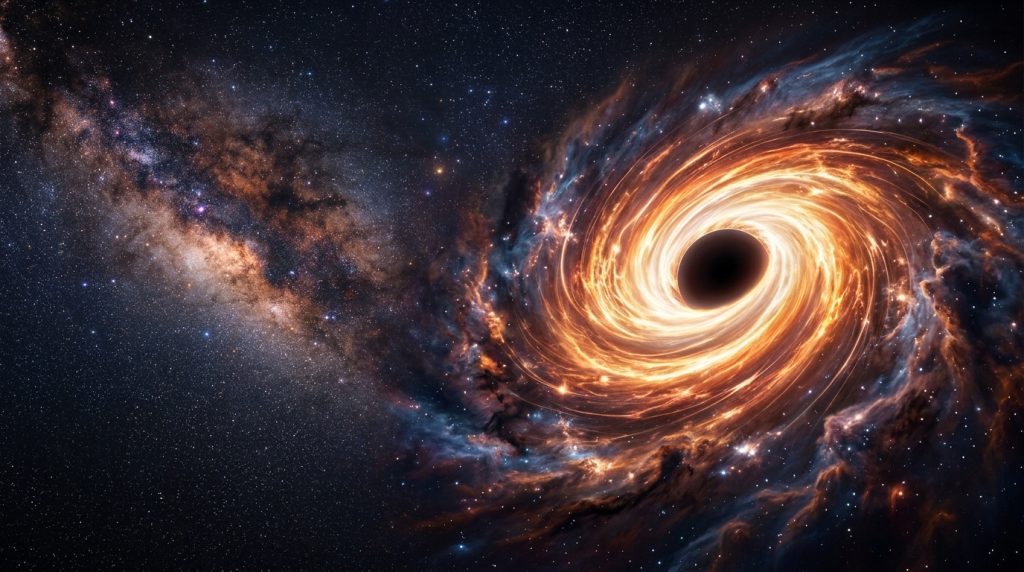
For millennia, humanity viewed the cosmos through a single medium: electromagnetic radiation (visible light, radio waves, X-rays, and gamma rays). However, the universe’s most violent cosmic cataclysms—supermassive black hole accretion discs, blazar relativistic jets, and core-collapse supernovae—are often obscured by dense gas clouds. The 2026 Nobel Prize in Physics awarded to Francis Halzen and the IceCube Collaboration marks the official maturation of an entirely new observational paradigm: high-energy neutrino astronomy.
What Are Neutrinos and Why Are They “Ghost Particles”?
Neutrinos are fundamental leptons with nearly zero mass and neutral electric charge. Created during extreme nuclear reactions and ultra-high-energy cosmic particle collisions, they interact with matter almost exclusively through the weak nuclear force. Every second, roughly 100 billion solar neutrinos pass through your thumbnail without touching a single atom.
Because they carry no charge, neutrinos are not deflected by interstellar magnetic fields, and because they rarely collide with gas, they travel straight through cosmic clouds across billions of light-years. They point like an unbent laser straight back to their energetic points of origin.
The Antarctic IceCube Giant Cherenkov Detector
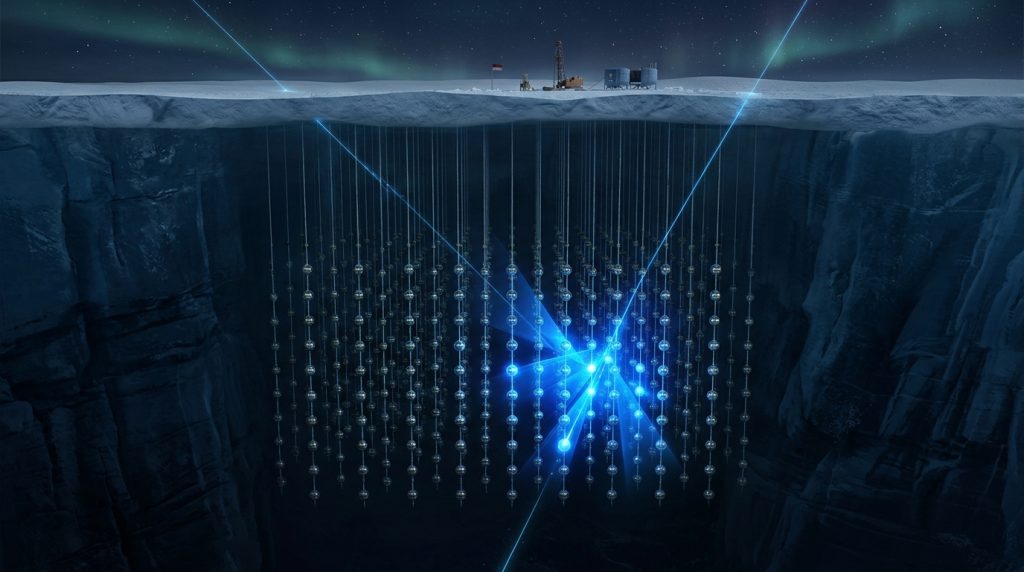
To capture particles that pass through light-years of lead without hitting anything, scientists turned a cubic kilometer of pristine South Pole glacial ice into the world’s most sensitive optical telescope:
- Depth: Buried between 1,450 meters and 2,450 meters below the Antarctic ice sheet, isolated from surface atmospheric noise.
- Digital Optical Modules (DOMs): 5,160 ultra-sensitive photomultiplier tubes suspended along 86 vertical boreholes melted into the ice.
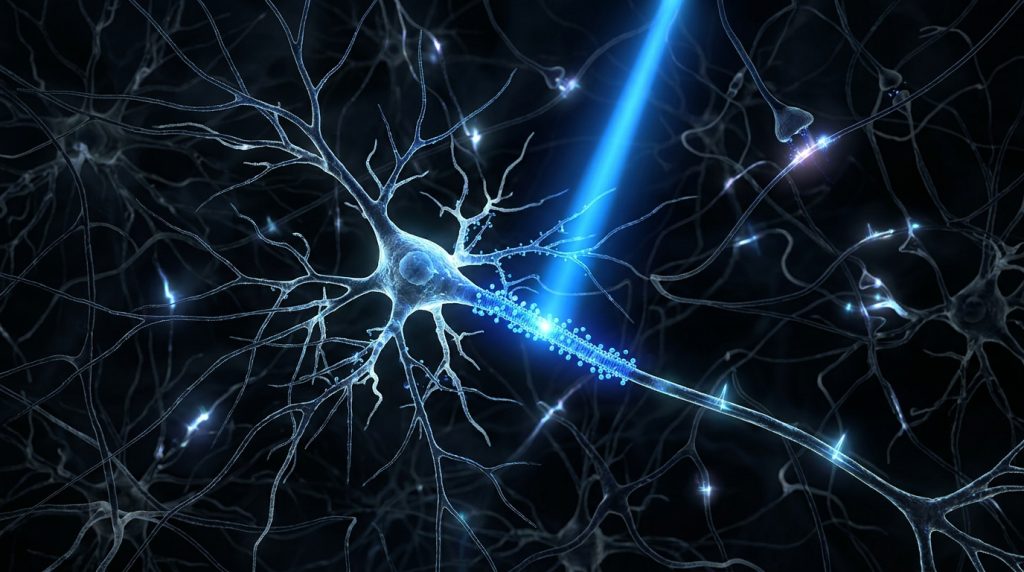
- Cherenkov Radiation Detection: On the rare occasion that an ultra-high-energy cosmic neutrino collides head-on with an oxygen or hydrogen nucleus in the ice, it generates a relativistic muon or cascade of charged secondary particles traveling faster than the phase velocity of light in ice, creating a faint conical flash of blue Cherenkov light.
Historical Triumphs: Mapping Blazar TXS 0506+056 and the Milky Way
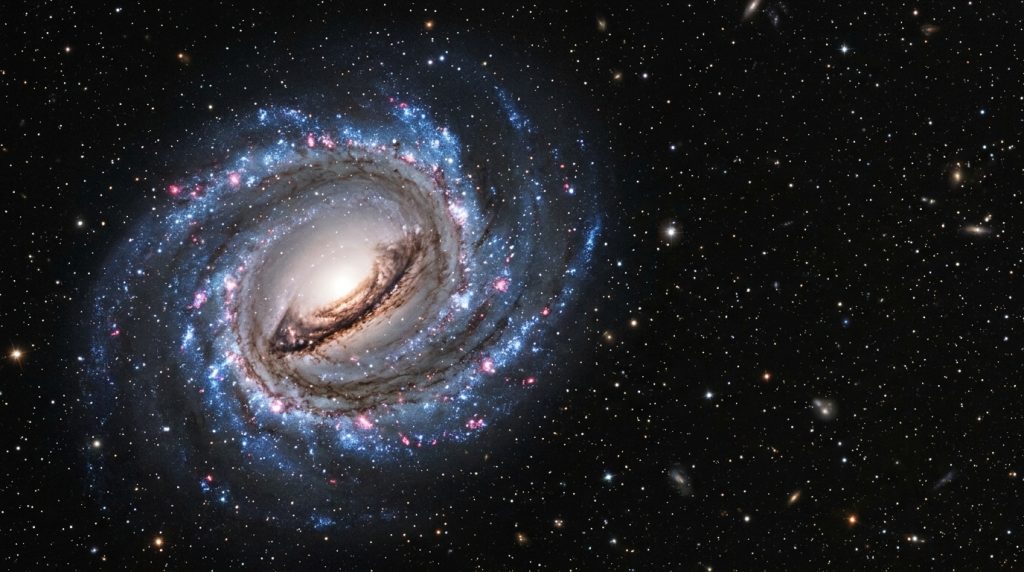
IceCube proved neutrino astronomy’s viability by pinpointing the active blazar galaxy TXS 0506+056 in 2017 in tandem with gamma-ray space telescopes, and in 2023, by producing the first-ever neutrino portrait of our own Milky Way galaxy. The 2026 Nobel Prize cements neutrino detection as an indispensable pillar of multi-messenger astrophysics.