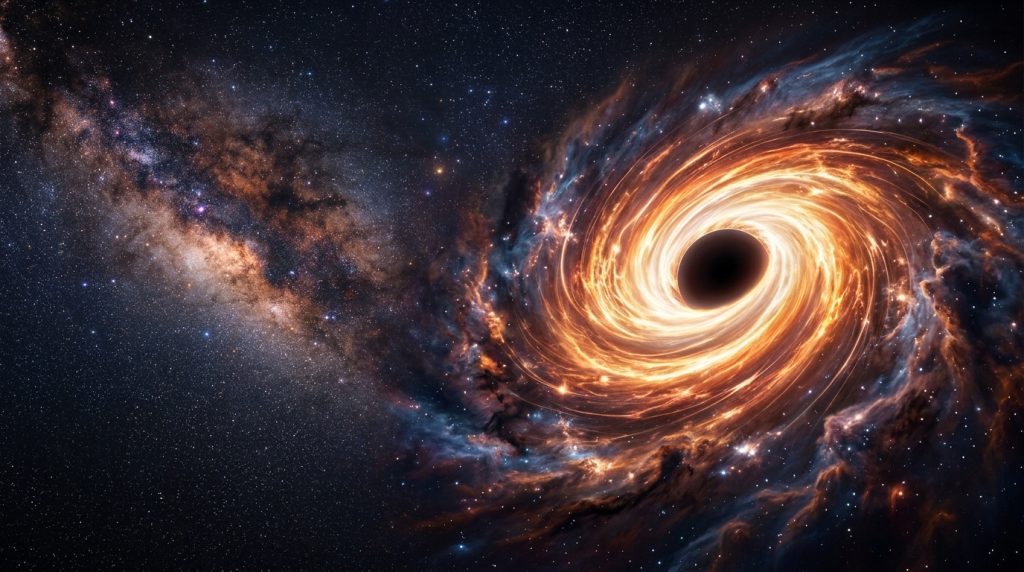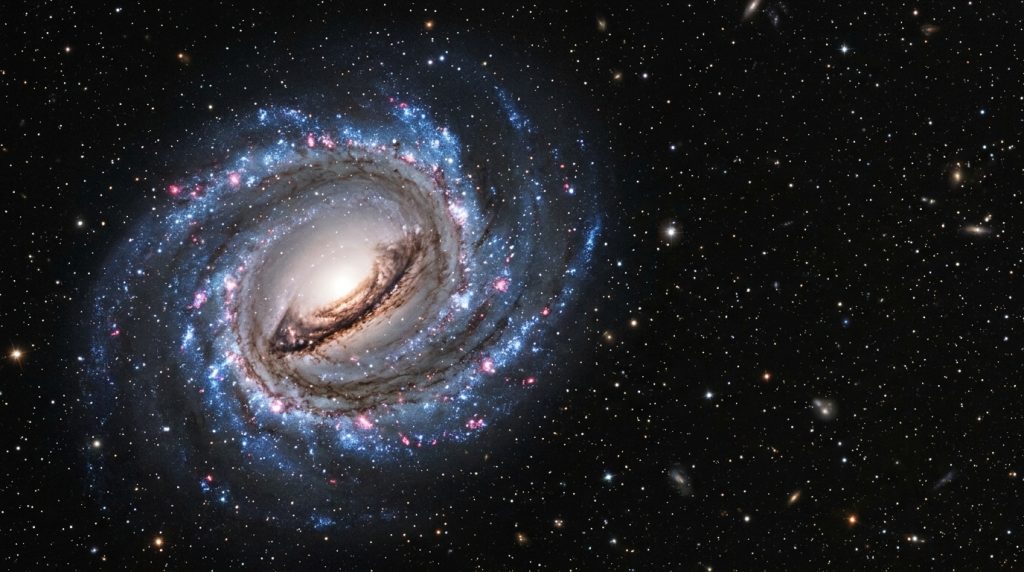
Located roughly 17 million light-years away in the constellation Coma Berenices, Messier 64 (M64)—popularly known as the “Black Eye” or “Evil Eye” Galaxy—has fascinated astronomers since its discovery in 1779. Even through a modest amateur telescope, its defining visual feature stands out: a prominent, sinister dark band of absorbing interstellar dust blotting out the radiant stellar core.
However, when modern spectrographs analyzed the kinematics of M64, they discovered a dynamical impossibility: the galaxy’s gas is spinning in two opposite directions simultaneously. Now, synthesized multi-wavelength observations combining the Hubble Space Telescope and the James Webb Space Telescope (JWST) have finally solved this cosmic puzzle.
The Counter-Rotating Dual Disc Phenomenon
Spectroscopic velocity mapping reveals that Messier 64 contains two distinct, concentric kinematic zones:
- The Inner Core Disc (Radius < 3,000 light-years): Composed of older stars and the dense dust lane, rotating in one direction with the bulk of the galaxy’s stellar mass.
- The Outer Gas Disc (Radius out to 40,000 light-years): A vast reservoir of cold hydrogen gas rotating in the exact opposite (retrograde) direction.
The Ancient Retrograde Galactic Cannibalism
How can a single galaxy rotate against itself? JWST’s near-infrared and mid-infrared imaging confirm the prevailing collision model:
- Roughly one billion years ago, a massive spiral galaxy collided with a smaller, gas-rich satellite dwarf galaxy on a direct retrograde orbital trajectory.
- The dwarf galaxy was gravitationally torn apart and absorbed into the host galaxy’s halo.
- While the stars of the dwarf dispersed into faint stellar streams, its counter-rotating interstellar gas fell inward, creating an oppositely orbiting outer disc.
The Starburst Shear Zone
Where the inner and outer counter-rotating discs grind against each other, gas clouds collide at relative speeds exceeding 300 km/s. This catastrophic friction generates enormous interstellar shockwaves, compressing hydrogen into dense molecular clumps that trigger a brilliant ring of active starburst formation, illuminated brilliantly by newborn massive blue stars and captured in exquisite detail by JWST.