For centuries, the greatest challenge in brain research was precision. Electrical electrodes stimulate broad swathes of brain tissue indiscriminately, while pharmacological drugs act sluggishly over minutes or hours. The 2026 Nobel Prize in Physiology or Medicine celebrates the ultimate breakthrough in neurological precision: Optogenetics—the revolutionary methodology that uses pulses of light to activate or silence genetically targeted individual neurons with millisecond precision.
The Core Mechanism: Microbial Opsins and Light-Gated Channels
The foundation of optogenetics originates in green pond algae (Chlamydomonas reinhardtii). These organisms utilize light-sensitive transmembrane proteins called rhodopsins to detect sunlight:
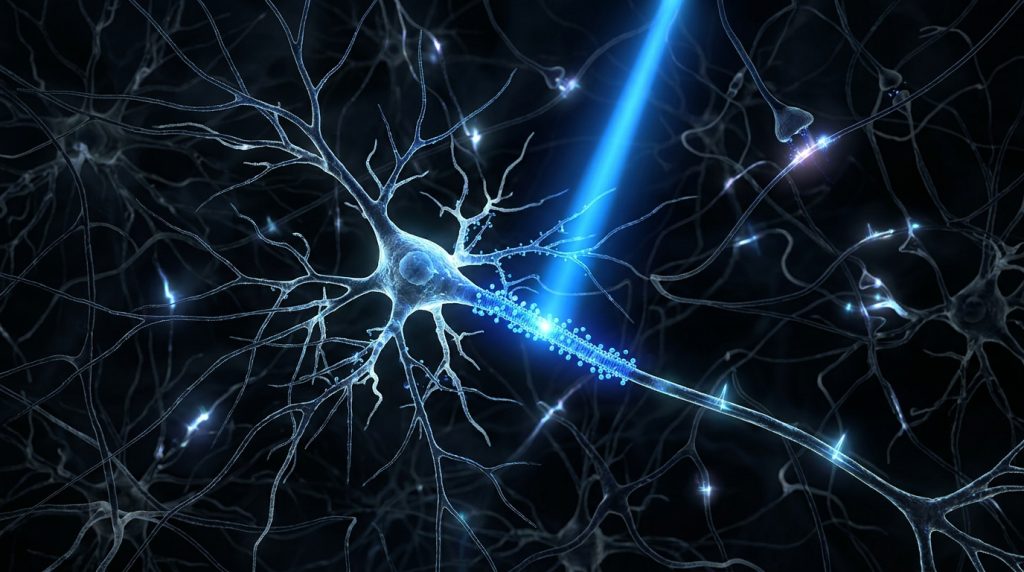
- Channelrhodopsin-2 (ChR2): When illuminated by blue light (~470 nm), this ion channel opens, allowing positive sodium ($Na^+$) and calcium ($Ca^{2+}$) ions to flood into the neuron, triggering an immediate action potential spike (neural activation).
- Halorhodopsin (NpHR): When struck by yellow/amber light (~590 nm), this chloride pump drives negative chloride ($Cl^-$) ions into the cell, hyperpolarizing the membrane and instantly shutting off neural firing (neural inhibition).
How Optogenetics is Applied in the Laboratory
- Genetic Delivery via Viral Vectors: The opsin gene is packaged inside an adeno-associated virus (AAV) paired with a cell-type-specific promoter, ensuring only desired neurons (such as dopamine receptors or GABAergic interneurons) express the protein.
- Fiber-Optic Cannula Implantation: Microscopic optical fibers are positioned above the targeted brain region.
- Real-Time Behavioral Modulation: Pulsing a blue laser activates motor circuits instantly, causing a resting animal to turn, run, stop anxiety behaviors, or recover memories on command.
Therapeutic Applications: From Blindness to Parkinson’s
Optogenetics has moved from animal research into clinical human trials: restoring partial vision to patients with retinitis pigmentosa by expressing channelrhodopsin in retinal ganglion cells, and pioneering closed-loop deep-brain optical pacemakers for Parkinson’s disease and severe treatment-resistant depression.