Traditional smart homes have long been plagued by the fundamental limitation of passive infrared (PIR) motion detectors: they only see movement. The moment you sit down on a couch to read a book, work at your computer, or step into a shower, the sensor assumes the room is vacant and plunges you into darkness. This frustrating “waving arm dilemma” has made presence-based home automation notoriously unreliable—until the arrival of affordable Frequency Modulated Continuous Wave (FMCW) millimeter-wave (mmWave) radar modules.
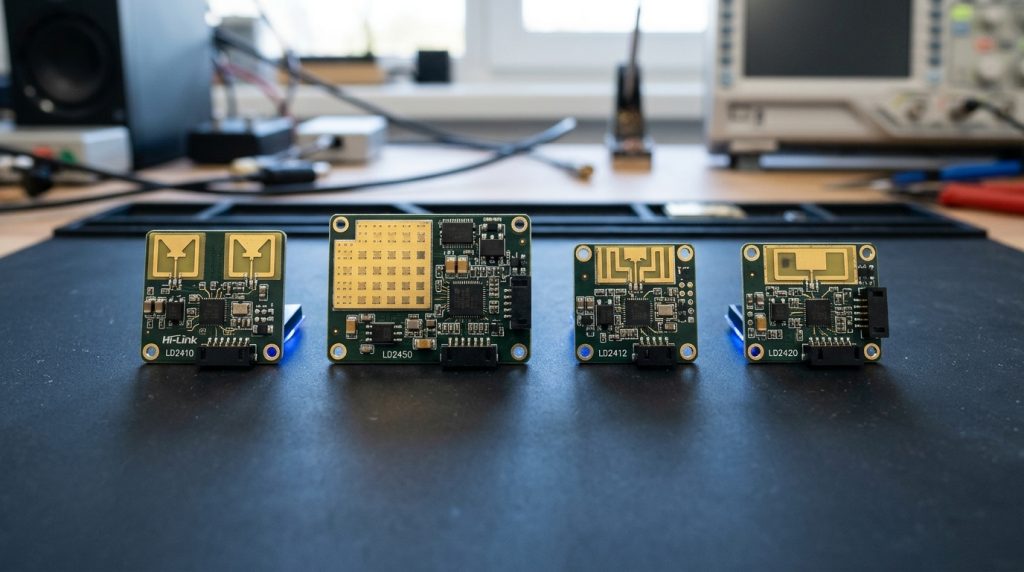
Among the wide variety of micro-radar solutions available for DIY enthusiasts and hardware engineers, the modules manufactured by Hi-Link have emerged as the undisputed industry standard. Operating primarily in the 24 GHz ISM industrial band, these sensors can detect subtle chest deflections caused by human breathing from several meters away. However, choosing between the HLK-LD2410, HLK-LD2450, HLK-LD2412, and HLK-LD2420 can be challenging because each sensor is engineered for fundamentally different spatial detection paradigms.
FMCW Radar Fundamentals: How mmWave Senses Static Presence
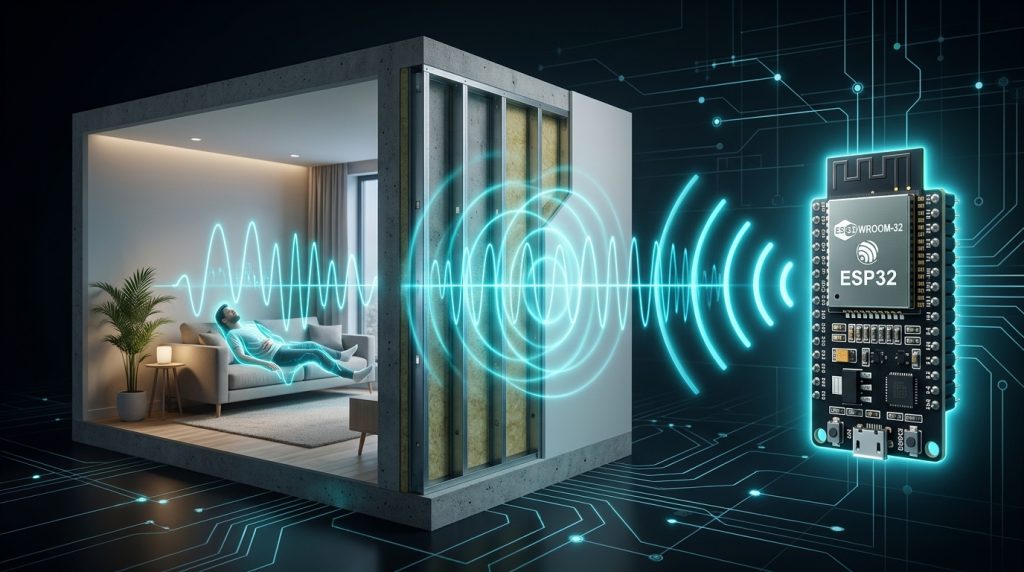
Unlike ultrasonic sensors that measure acoustic time-of-flight or PIR sensors that detect differential thermal infrared radiation, FMCW mmWave radar transmits a continuous chirped radio frequency signal between 24.00 GHz and 24.25 GHz. When this high-frequency electromagnetic wave reflects off stationary or moving objects, the sensor’s receiver mixes the reflected echo with the transmitted signal to extract the beat frequency.
Through Fast Fourier Transform (FFT) and micro-Doppler signal processing, the internal DSP calculates three vital parameters:
- Target Distance: Determined by dividing the surveillance volume into discrete spatial bins called distance gates (typically 0.75m per gate).
- Target Velocity: Measured via Doppler frequency shift, allowing differentiation between high-speed movement (walking) and subtle micro-movements (breathing, heartbeats, keyboard typing).
- Signal Energy Amplitude: Indicates target cross-sectional reflection strength, enabling precise threshold filtering to eliminate unwanted triggers like ceiling fans or fluttering curtains.
Hi-Link mmWave Family Technical Comparison Matrix
To help you select the exact radar module for your room layout, the following comprehensive engineering matrix breaks down their core specifications:
| Feature / Specification | HLK-LD2410 (B/C) | HLK-LD2450 | HLK-LD2412 | HLK-LD2420 |
|---|---|---|---|---|
| Operating Frequency | 24.00 – 24.25 GHz (ISM) | 24.00 – 24.25 GHz (ISM) | 24.00 – 24.25 GHz (ISM) | 24.00 – 24.25 GHz (ISM) |
| Antenna Configuration | 1T1R (Scalar Distance) | 2T4R (Array MIMO / Angles) | 1T1R (Wide-beam Patch) | 1T1R (Ultra-compact) |
| Detection Paradigm | Distance Gates (0 to 8) | X-Y Plane Tracking (2D) | Wide-angle Gates (0 to 13) | Basic Motion / Presence |
| Simultaneous Targets | 1 Dominant Target | Up to 3 Concurrent Targets | 1 Dominant Target | 1 Dominant Target |
| Maximum Range | 6 meters (Static: 5m) | 6 meters (Tracking: 6m) | 9 meters (Static: 6m) | 8 meters (Static: 5m) |
| Azimuth Detection Angle | ±60° (120° total) | ±60° (120° total) | ±75° (150° total) | ±60° (120° total) |
| Supply Voltage & Current | 5V DC (Peak ~80mA) | 5V DC (Peak ~250mA) | 5V DC (Ultra-low ~38mA) | 3.3V – 5V DC (~50mA) |
| Bluetooth Tuning App | Yes (HLKRadarTool iOS/Android) | Yes (HLKRadarTool) | Yes (HLKRadarTool) | No (UART configuration tool) |
| ESPHome Support | Native official component | Official & custom component | Native UART / External | Native official component |
Deep-Dive Analysis of Each Hi-Link Module
1. HLK-LD2410 (The Gold Standard for Static Presence)
The HLK-LD2410 (available in LD2410B with Bluetooth and LD2410C with a pin header) is the undisputed workhorse for single-room presence automation. It divides its 6-meter range into 8 distinct gates (each ~75 cm). For every individual gate, you can configure independent sensitivity thresholds (0-100) for both moving and static states.
This granular tuning makes it virtually immune to false alarms: if a ceiling fan rotates at gate 4, you simply raise the motion threshold for gate 4 to 85 while keeping gate 2 (where you sit on the chair) at high sensitivity (threshold 15). Furthermore, its dedicated GPIO OUT pin goes HIGH whenever presence is detected, offering instantaneous zero-latency relay control.
2. HLK-LD2450 (Multi-Target Spatial Coordinate Tracking)
While scalar sensors only report how far away a person is, the HLK-LD2450 utilizes a complex 2T4R (two transmit, four receive) antenna array to calculate both the distance and azimuth angle of up to three people simultaneously. It streams exact real-time (X, Y) coordinates and velocity vectors over 256000 baud UART.
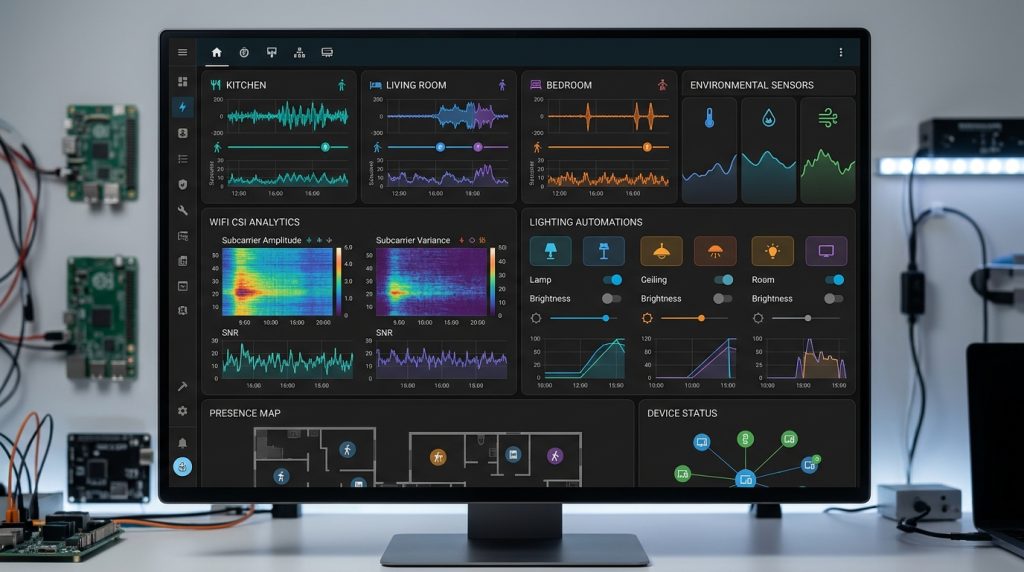
With an LD2450 mounted on a wall, Home Assistant can create spatial polygon zones: when you move from your bed (Zone A) to your desk (Zone B), your desk lamp illuminates while your bed reading light turns off automatically. It represents the pinnacle of multi-occupancy automation.
3. HLK-LD2412 (Ultra-Wide Angle and Long Range)
Engineered with a newly designed planar antenna structure, the HLK-LD2412 expands the horizontal azimuth coverage to an impressive ±75° (150° total) and reaches up to 9 meters across 14 discrete gates. Its power consumption drops significantly to ~38 mA, making it exceptionally well-suited for hallway installations and battery-assisted IoT setups.
4. HLK-LD2420 (Cost-Effective Micro Node)
The HLK-LD2420 features an integrated single-chip SoC architecture, eliminating external microcontrollers to deliver the lowest cost footprint. While it lacks native Bluetooth configuration, it provides rock-solid presence gating over a standard 115200 baud serial connection, making it ideal for mass-deployment in commercial lighting retrofits.
Production-Ready ESPHome Configuration for HLK-LD2410
Integrating the HLK-LD2410 into ESPHome and Home Assistant requires only a few lines of configuration using the native ld2410 component over hardware UART:
uart:
  id: uart_radar
  tx_pin: GPIO17
  rx_pin: GPIO16
  baud_rate: 256000
  parity: NONE
  stop_bits: 1

ld2410:
  uart_id: uart_radar
  throttle: 500ms

binary_sensor:
  - platform: ld2410
    has_target:
      name: "Room Presence Detected"
    has_moving_target:
      name: "Room Moving Target"
    has_still_target:
      name: "Room Still Target"

sensor:
  - platform: ld2410
    moving_target_distance:
      name: "Moving Target Distance"
      unit_of_measurement: "cm"
    still_target_distance:
      name: "Still Target Distance"
      unit_of_measurement: "cm"
    detection_distance:
      name: "Detection Distance"
      unit_of_measurement: "cm"
Practical Recommendations for False Trigger Elimination
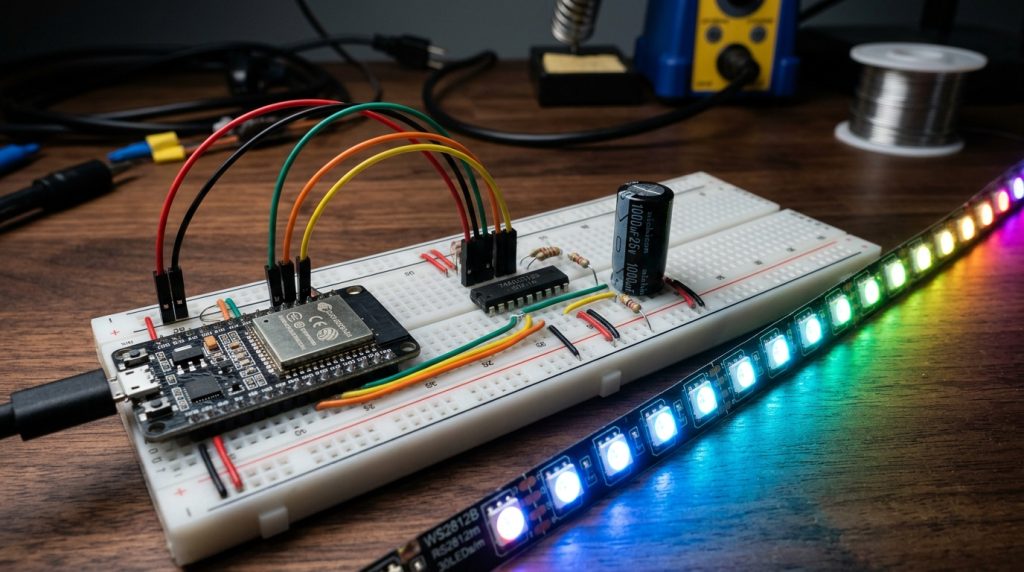
- Power Rail Stability: Radar transceivers generate transient RF bursts. Powering an LD2450 directly from a weak 3.3V rail will cause brownouts and phantom targets. Always power the module from a clean 5V rail with at least a 100uF electrolytic capacitor soldered close to VCC and GND.
- Enclosure Materials: Radio waves at 24 GHz easily penetrate dry drywall, wood, glass, and standard plastics (PLA, PETG, ABS). Never mount the sensor behind metallic paint, metal plates, or dense wet masonry.
- Air Conditioning Drafts: While radar does not see hot air, it easily detects fluttering plant leaves or curtains pushed by ventilation. Use gate exclusion or increase gate threshold values to filter out static ambient vibrations.