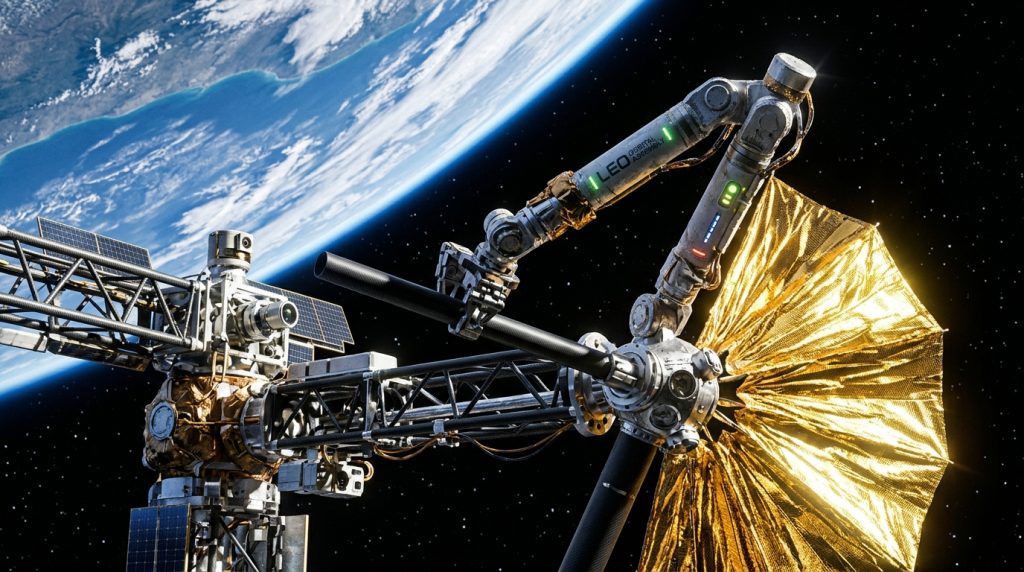
Across science fiction literature and cinema, colossal rotating space stations, kilometer-scale sensor arrays, and orbital solar power farms have long symbolized humanity’s cosmic future. Yet since the dawn of the space age, aerospace engineers faced an unyielding physical constraint: the diameter of the rocket payload fairing. Historically, deploying large structures required only two compromises: either folding them intricately like origami and praying for flawless robotic deployment (as with the James Webb Space Telescope), or launching dozens of payloads for astronauts to piece together manually during hazardous extravehicular activities (EVA), as demonstrated by the International Space Station (ISS).
On November 5, 2026, that paradigm fundamentally shattered. Researchers at the California Institute of Technology (Caltech), in collaboration with DARPA (Defense Advanced Research Projects Agency), announced that an autonomous robot in low-Earth orbit (LEO) successfully constructed a structural truss without any human physical intervention or astronaut assistance. The technology demonstration, titled ASTRA (Autonomous In-Space Tensioned Reflector Assembly), inaugurates an era where orbital architectures are no longer constrained by the dimensions of Earth-launched rockets.
The DARPA NOM4D Vision: Manufacturing in the Void
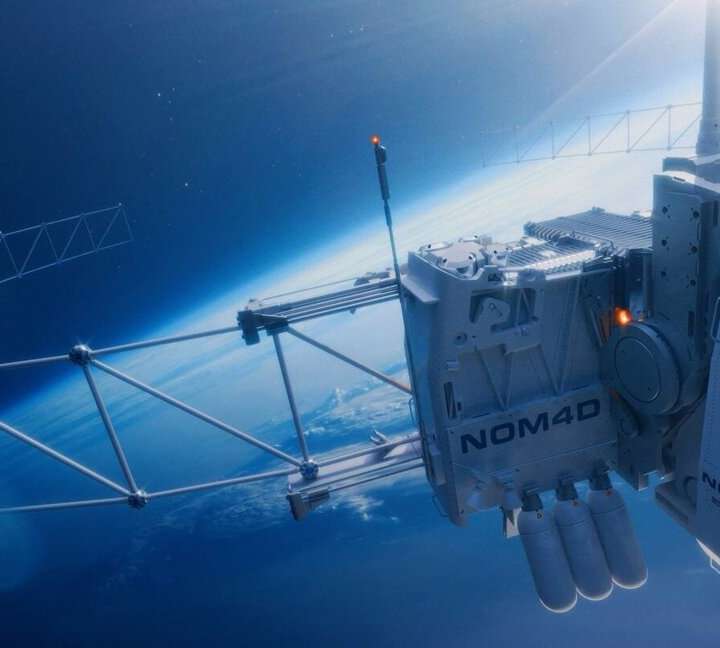
Established in 2022, DARPA’s NOM4D (Novel Orbital and Moon Manufacturing, Materials, and Mass-efficient Design) initiative was conceived to ferry raw, mass-efficient feedstocks from Earth and execute primary structural manufacturing directly in orbit. As stated by DARPA NOM4D program manager Andrew Detor, the core objective is to unlock structures spanning hundreds of meters or kilometers—scales fundamentally unattainable through terrestrial prefabrication.
Conceived at Caltech’s Space Structures Laboratory under the leadership of Professor Sergio Pellegrino, the ASTRA payload flew aboard Momentus’s Vigoride orbital service vehicle. ASTRA represents one of only two elite projects selected for NOM4D Phase 3 orbital flight validation, successfully demonstrating end-to-end structural autonomy in the vacuum of space.
How ASTRA Autonomously Built a Truss in Orbit
Operating hundreds of kilometers above Earth under microgravity, extreme radiative thermal cycling, and ultra-high vacuum, the robotic builder executed an intricate series of autonomous mechanical sequences:
- Component Dispensing and Acquisition: A precision three-axis Cartesian gantry robotic mechanism extracted high-modulus carbon-fiber composite tubes and aluminum node joints from motorized feed cartridges.
- Snap-Fit Structural Locking: Robotic end-effectors maneuvered the structural struts into corresponding nodal receptacles, seating and locking the snap-fit connectors with tactile load-verification feedback.
- Tensioned Reflector Film Deployment: Once the rigid bay was established, the robot tensioned an ultrathin, micro-perforated Kapton membrane developed jointly by Caltech and the University of Pennsylvania. Unlike heavy knitted metallic wire mesh, this proprietary perforated film demands significantly lower tension to retain its precise parabolic profile, drastically cutting overall supporting mass.
- Sequential Ejection Loop: Upon bay completion, the integrated mechanism indexed the assembled section outward into open space, clearing the internal workspace to immediately begin assembling the subsequent bay. The full architecture envisions an 11-bay linked reflector antenna array.
Calculating truss bay geometries, circular chord lengths, and angular tolerances represents an exact science. Similar to the geometric relationships explored in our technical tool for Hole Count, Chord, Central Angle, and Arc Length Calculation, orbital structural robotics requires sub-millimeter trigonometric fidelity to ensure kinematic stability across fluctuating thermal orbital passes.
Overcoming In-Orbit Anomalies with Earth-Based Twin Hardware
Building in space inevitably presents physics-level surprises that cannot be fully replicated in terrestrial cleanrooms. Communication with ASTRA was strictly restricted to seven or eight brief 15-minute orbital contact passes each day, demanding maximum operational efficiency from the operations team.
Whenever telemetry photos flagged kinematic resistance or microgravity clearance anomalies, Caltech engineers turned to a flight-spare duplicate unit maintained at Pellegrino’s Pasadena laboratory. By reproducing anomalies on the ground twin, researchers diagnosed friction quirks, refined motor control routines, and transmitted validated command packets during the next operational orbital pass.
The Gateway to Kilometer-Scale Space Infrastructure
The successful autonomous construction of an orbital truss fundamentally decouples space architecture from rocket dimensions:
| Mission Application | Conventional Method (Deployable / Astronaut EVA) | In-Space Autonomous Assembly (ISAM / ASTRA) |
|---|---|---|
| Deep Space Telescopes | Hard-capped at 6–10 meters by rocket fairing envelope | Unbounded 30–100+ meter aperture optical/radio arrays |
| Space-Based Solar Power | Economically unfeasible via pre-assembled launches | Kilometer-wide orbital photovoltaic collector platforms |
| RF & Cislunar Radars | Heavy mechanical hinges susceptible to deployment jamming | Ultralight, modular composite trusses with superior stiffness |
| Operational Risk & Cost | Severe astronaut safety hazards and extreme launch mass | Zero human risk, optimized mass fractions, full autonomy |
Initiatives such as Caltech’s Space Solar Power Project—which aims to harvest sunlight uninterrupted in orbit and beam electricity to terrestrial receiving grids via microwaves—depend entirely on scalable in-space assembly. With ASTRA’s demonstration, constructing kilometer-scale structures in the void has officially transitioned from science fiction into proven engineering reality.
Sources and References
This technical report references official institutional announcements and scientific publications:
- California Institute of Technology (Caltech) – Robotic Space Demo Successfully Builds in Space
- ScienceDaily – Caltech Robot Makes History by Building a Structure in Space
- DARPA – Novel Orbital and Moon Manufacturing, Materials and Mass-efficient Design (NOM4D) Program
- SciNexic – Caltech’s ASTRA Just Built the First Structure in Space Without Astronauts
- Phys.org – Robot Successfully Builds Space Structure in First Autonomous Demo