For nearly a century, condensed matter physics categorized all magnetically ordered materials into two fundamental collinear paradigms: Ferromagnetism—the ubiquitous force behind electric motors, compass needles, and magnetic recording media—and Antiferromagnetism, the fully compensated magnetic order discovered by Louis Néel that earned the 1970 Nobel Prize in Physics. Yet rigorous theoretical modeling confirmed by breakthrough synchrotron angle-resolved photoemission spectroscopy (ARPES) has overturned this binary classification, establishing a third distinct fundamental magnetic state: Altermagnetism.
Celebrated by Science magazine among its premier breakthroughs and honored with the prestigious 2026 Europhysics Prize, altermagnetism unites the hallmark functional property of ferromagnets—highly spin-polarized electrical transport—with the definitive operational advantages of antiferromagnets: zero macroscopic magnetic stray fields and ultrafast terahertz (THz) switching dynamics. This phase represents a foundational leap forward for spintronic data architectures and dissipationless computing.
The Historical Dichotomy: Ferromagnetism vs. Antiferromagnetism
Appreciating the technological significance of altermagnets requires examining the classical trade-offs between ferromagnets and antiferromagnets:
- Ferromagnetism: Atomic electron spins align parallel to one another across magnetic domains, generating a net macroscopic magnetic dipole moment. While this macroscopic magnetization permits straightforward electrical read/write manipulation in spin-torque memory, the resulting dipolar stray fields cause cross-talk between closely packed nanoscale bit cells, enforcing an immutable density limit. Furthermore, ferromagnetic resonance frequencies constrain switching speeds to the low gigahertz (GHz) domain.
- Antiferromagnetism: Adjacent atomic magnetic moments align antiparallel in alternating sublattices, perfectly canceling out any net external magnetic moment. Without magnetic stray fields, neighboring memory cells do not interact, and operational resonance reaches the terahertz (THz) threshold. However, due to combined time-reversal and spatial inversion symmetries (Kramers degeneracy), electronic energy bands remain completely spin-degenerate across momentum space. Consequently, reading and modulating state information via electrical currents is exceedingly difficult.
Physical Foundations of Altermagnetism: Crystal Symmetry and d-Wave Spin Splitting
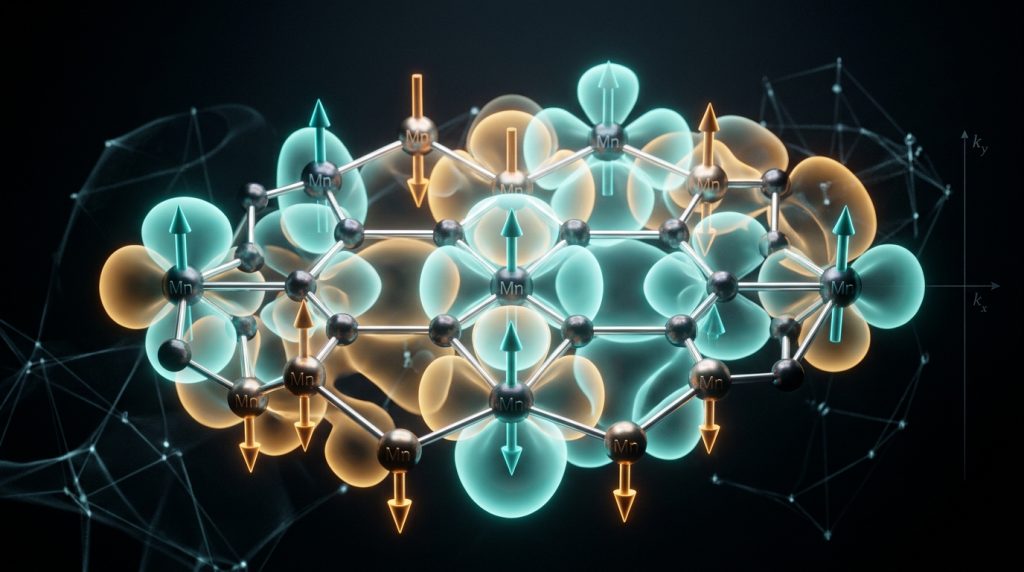
Altermagnets originate from an unconventional coupling between spatial crystallographic rotation and spin coordinate space. In real space, opposite-spin sublattices exhibit perfectly antiparallel orientations that sum to strictly zero net magnetization, precluding any external stray magnetic flux.
Crucially, however, the opposing spin sublattices cannot be mapped onto one another through pure spatial translation or spatial inversion; instead, they are interconnected exclusively via crystal rotation or roto-reflection symmetries. When conduction electrons propagate through this anisotropic crystal potential in momentum space (reciprocal k-space), time-reversal symmetry is broken without invoking relativistic spin-orbit coupling. This produces gigantic electronic band splitting (often exceeding 1 eV) with alternating d-wave, g-wave, or i-wave nodal symmetries. Thus, despite zero net magnetic moment, altermagnets naturally support fully spin-polarized electrical currents comparable to conventional ferromagnets.

In materials science, crystal lattice symmetries and atomic strain distributions govern macroscopic phase behavior. As detailed in our engineering analysis on Carbon Equivalent (CE) Calculation and Weldability Analysis, microstructural phase stability dictates mechanical cracking susceptibility. Similarly, in quantum condensed matter, sub-nanometer rotational distortions break electronic degeneracy, giving rise to novel topological matter phases.
Comparative Matrix Across the Three Fundamental Magnetic Orders
The comparative physical and spintronic characteristics of ferromagnetism, antiferromagnetism, and altermagnetism are outlined below:
| Physical Property | Ferromagnetism (FM) | Antiferromagnetism (AFM) | Altermagnetism (AM) |
|---|---|---|---|
| Real-Space Net Magnetization | Non-zero (Strong magnetic dipole) | Zero (Collinear cancellation) | Zero (Fully compensated sublattices) |
| External Magnetic Stray Fields | Present (Inter-cell magnetic cross-talk) | Absent | Absent (Ultra-dense bit scalability) |
| Momentum-Space Spin Splitting | Present (Global band polarization) | Absent (Kramers degeneracy preserved) | Present (Gigantic non-relativistic splitting) |
| Spin-Polarized Transport Current | Readily generated and sustained | Extremely weak or absent | Robust (Equal to ferromagnets) |
| Dynamic Switching Threshold | Gigahertz (GHz) scale | Terahertz (THz) scale | Terahertz (THz) scale |
| Benchmark Material Examples | Iron (Fe), Cobalt (Co), Nickel (Ni) | NiO, MnO, FeMn | MnTe, CrSb, RuO2 |
Experimental Verification: ARPES and the SLAC Chirality Breakthrough
Originally formulated theoretically between 2019 and 2022 by Libor Šmejkal, Jairo Sinova, and Tomas Jungwirth, altermagnetism swiftly moved from theoretical equations to direct experimental validation across international light source facilities:
- Manganese Telluride (α-MnTe): As a benchmark g-wave altermagnet (Néel temperature 307 K), Spin-ARPES measurements directly visualized asymmetric band splitting emerging precisely as temperature dipped below the magnetic ordering threshold, lifting Kramers degeneracy without net magnetization.
- Chromium Antimonide (CrSb): With a colossal Néel temperature of 705 K (432 °C)—well above ambient operating environments—CrSb exhibits gigantic spin splitting of ~1 eV near the Fermi surface, establishing it as a primary material platform for ambient-temperature device fabrication.
- SLAC Chirality Proof (October 2026): In late 2026, researchers at the Stanford SLAC National Accelerator Laboratory published in Science the definitive missing link: resonant X-ray diffraction that directly observed magnetic chirality (“handedness”) in MnTe, providing irrefutable empirical proof of the altermagnetic state.
Technological Implications: Terahertz Spintronics and Beyond
By leveraging electron spin rather than electrical charge alone, altermagnetic physics unlocks profound architectural possibilities for modern hardware engineering:
- High-Density Non-Volatile MRAM: Because altermagnets produce zero dipolar stray fields, neighboring magnetic tunnel junctions (MTJs) can be packed at sub-nanometer intervals without magnetic cross-talk, multiplying MRAM storage density by orders of magnitude while virtually eliminating idle power dissipation.
- Terahertz Logic Gates: Free from the domain-wall inertia of ferromagnets, altermagnetic order responds at terahertz dynamics, offering prospective logic cycles that are up to a thousand times faster than existing silicon CMOS switches.
- Unconventional Superconductivity: Breaking time-reversal symmetry without generating internal magnetic fields positions altermagnets as ideal substrates to host topological chiral superconductors, offering fertile ground for decoherence-resistant quantum computational qubits.
Sources and References
This technical analysis references official research findings and peer-reviewed literature:
- SLAC National Accelerator Laboratory – Researchers Find Proof of Altermagnetism, a New Magnetic Phase
- ScienceDaily – SLAC Scientists Find Conclusive Proof of a Mysterious Third Type of Magnetism
- Johannes Gutenberg University Mainz – Science Lists Discovery of Altermagnetism as Scientific Breakthrough
- Institute of Physics of the Czech Academy of Sciences – Altermagnetism and Beyond: New Frontiers in Magnetism
- Nature Communities – Three-Dimensional Mapping of Altermagnetic Spin Splitting in CrSb