For four billion years on Earth, every living cell on the planet descended from a pre-existing living ancestor. While top-down synthetic biology (such as Craig Venter’s JCVI-syn3.0) stripped down natural bacterial genomes, creating an autonomous, living cell from scratch—assembling inanimate non-living molecules into an entity that self-maintains, metabolizes, grows, and divides—remained an elusive dream. That barrier has officially been breached with SpudCell.
What is SpudCell?
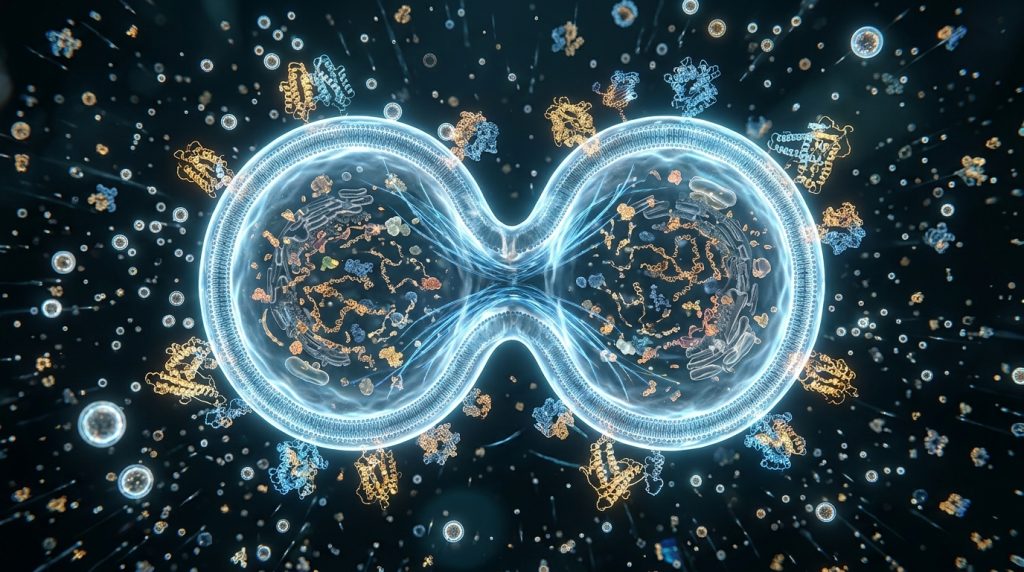
Developed through a global bottom-up synthetic biology consortium, SpudCell (named for its initial potato-like morphological elongation) is a fully synthetic biological protocell engineered purely from purified proteins, synthetic DNA plasmids, and synthetic phospholipid bilayers:
- Synthetic Cell Membrane: A dynamic lipid vesicle bilayer engineered with asymmetric leaflet tension to facilitate mechanical deformation without bursting.
- Cell-Free Transcription-Translation (TX-TL): A purified biochemical enzymatic engine capable of synthesizing structural proteins directly from encapsulated DNA blueprints.
- Metabolic Energy Regeneration: An engineered ATP regeneration pathway driven by encapsulated pyruvate and inorganic phosphate.
The Cytokinesis Breakthrough: How SpudCell Divides
Previously, artificial vesicles could swell with water, but lacked the internal force generation to pinch their middle and split into two daughter cells. SpudCell solves this by expressing synthetic ring-forming proteins analogous to the bacterial FtsZ and eukaryotic actin contractile rings:
- The cell synthesizes membrane-anchored filament proteins inside the vesicle lumen.
- The filaments spontaneously polymerize into a continuous circumferential belt along the cell equator.
- As ATP is consumed, the ring generates constriction force, pinching the lipid bilayer into a dumbbell shape.
- Membrane scission occurs cleanly, yielding two genetically identical, metabolically active daughter cells.
Significance for the Origin of Life and Medicine
SpudCell provides tangible evidence for how prebiotic protocells may have transitioned from inanimate organic chemistry to living Darwinian organisms on the early Earth. Medically, programmable synthetic cells promise intelligent microscopic drug delivery vehicles capable of hunting cancerous cells, synthesizing therapeutic antibodies on-site, and biodegenerating harmlessly.