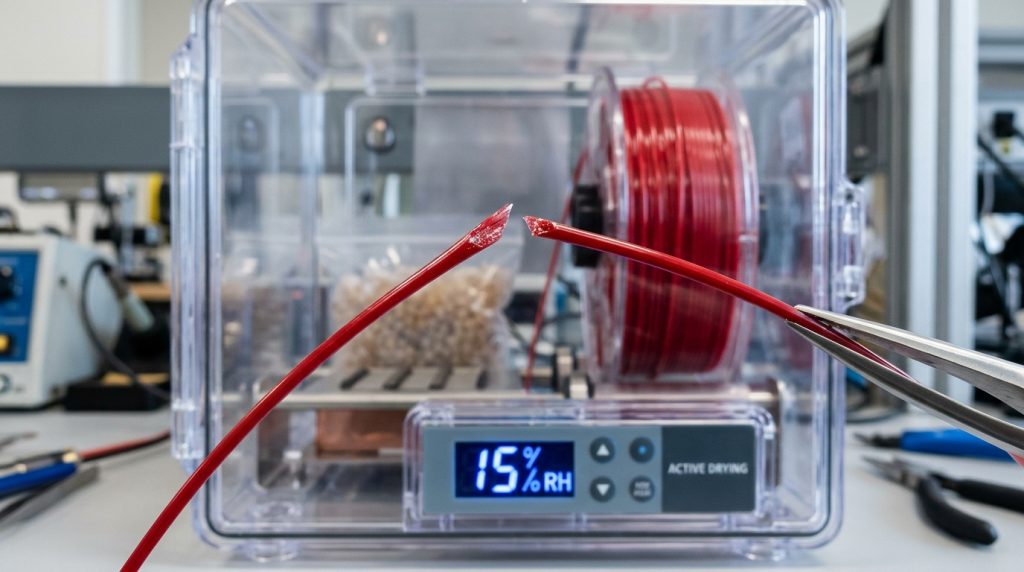
Almost every 3D printer owner has experienced this frustrating mystery: you leave a spool of high-quality Polylactic Acid (PLA) loaded on your printer for a week or two, and when you return, the filament has snapped cleanly off inside the Bowden tube or directly at the extruder drive gear. When you gently bend the loose strand with your fingers, it shatters like dry spaghetti instead of flexing smoothly.
Common wisdom often claims that “PLA has dried out,” but in reality, the exact opposite has occurred. The filament has absorbed ambient airborne moisture, triggering a destructive chemical reaction known as hydrolytic chain scission.
The Chemistry of Filament Embrittlement: Hydrolysis
PLA is a biodegradable thermoplastic polyester synthesized from renewable agricultural starch (typically corn or sugarcane) via bacterial fermentation into lactic acid, followed by ring-opening polymerization into poly-lactide polymer chains.
While PLA is significantly less hygroscopic than materials like Nylon (PA) or PETG, it is far from hydrophobic. When exposed to ambient indoor humidity (typically 40% to 70% Relative Humidity):
- Atmospheric Moisture Absorption: Polar ester bonds in the amorphous regions of the polymer strand attract atmospheric water molecules through hydrogen bonding.
- Hydrolytic Degradation: In the presence of ambient thermal energy, water molecules chemically attack the ester backbone bonds (hydrolysis).
- Chain Scission: The long, tangled polymer molecular chains that provide mechanical elasticity and tensile toughness break down into progressively shorter chain fragments.
- Micro-Crystallization: As molecular chain length shortens, mobility increases, allowing the polymer to reorganize into brittle crystalline structures that fracture under minimal bending stress.
Symptoms of Wet PLA in Active 3D Printing
Even before a spool becomes so brittle that it snaps on the spool, moisture trapped within the filament manifests in distinct print defects:
| Print Defect | Physical Mechanism |
|---|---|
| Crackling / Popping Sounds | Trapped liquid water enters the 210°C hotend, expands 1600x into steam, and violently bursts through the nozzle orifice. |
| Excessive Stringing & Oozing | Superheated steam lowers melt viscosity and creates internal vapor pressure that forces plastic out during retractions. |
| Rough, Pitted Wall Surfaces | Steam bubbles explode at the nozzle exit, leaving microscopic craters and voids in perimeter walls. |
| Drastic Layer Weakness | Steam voids prevent intimate molecular intertwining between successive layers, reducing Z-axis tensile strength by up to 50%. |
How to Properly Dry and Restore Brittle PLA
Once moisture has caused chemical chain scission, the lost molecular weight cannot be fully regenerated; however, thorough moisture removal restores substantial flexibility and halts further degradation:
- Target Drying Temperature: Bake the spool at 45°C to 50°C. Never exceed 52°C, as PLA’s glass transition temperature ($T_g$) sits around 55°C–60°C. Exceeding this boundary will cause the filament strands to fuse together into a solid unusable plastic donut.
- Drying Duration: Minimum 4 to 6 hours inside an active forced-air filament dryer or a modified food dehydrator. Passive desiccant boxes cannot extract moisture that is already chemically bound inside the plastic.
Long-Term Moisture Prevention and Storage
- Airtight Vacuum Bags with Indicator Desiccant: Store spools in heavy-duty vacuum seal bags with orange-to-green indicating silica gel packets.
- Direct Drybox Printing: Print directly from a heated or desiccant-sealed drybox equipped with PTFE reverse-Bowden tubes to ensure filament is never exposed to room humidity on its path to the hotend.